Tuesday, April 14, 2020

Check for Understanding Part Two: Three Things Great Athletes Have In Common

Teaching might be my day job, but that doesn't mean a good piece of pedagogy ought to go to waste! In my last postI offered a tip for parents as educators: Checking for Understanding. In today's topic, I'm going to run a theory by you. Test it out and have fun with it. The goal is two-fold. One: check for understanding the argument that I am going to make and two: discuss. Do you agree? Why or why not? 
That's right: What we are checking for understanding is a theory—a personal belief, a truth that I have found in reading and writing about professional athletes. I think this is especially true among female basketball players. You might think that is a very specific group, but for the point of your discussion, I encourage you to test it out on other sports/among all athletes. 

The April 2016 issue of High School Today, the magazine of NFHS: National Federation of State High School Associations (for Athletics) ran a profile of University of Virginia's women's basketball coach, Tina Thompson. The article "It all started here" reports
Before she became the WNBA all-time leading scorer, and before she was the first draft pick in the history of the WNBA, and even before she starred at Inglewood (California) Morningside High School, Tina Thompson got her start in basketball on the playground of West Los Angeles. 
Thompson would join her brother, TJ, and his friends at Robertson Park for pick up games. At Morningside, Thompson played basketball alongside fellow WNBA star Lisa Leslie, and also played volleyball. During her high school career, she scored more than 1500 points and collected more than 1000 rebounds. 
Thompson and Lesley teamed up again at Southern California, where they lead the Trojans to three NCAA tournament appearances. Thompson graduated in 1997 with a degree in sociology and a minor in psychology. 
In the initial WNBA draft, Thompson was drafted first by the Houston Comets. In Houston, Thompson led the Comets to four consecutive WNBA championships from 1997 to 2000. When she retired in 2013, Thompson was the WNBA's all-time leading scorer was 7488 points. Thompson was also a member of the 2004 and 2008 gold-medal-winning US Olympic teams. 
In 2015 Thompson was hired as an assistant coach at the University of Texas.
A few important post-scripts include: In 2018, she was named head coach of the University of Virginia Cavaliers women's basketball team. She has been surpassed by Diana Taurasi as the all-time scoring leader, ranking an impressive number two and it should be noted she adds another chapter to the heroics of The Women of Troy!
Reading Thompson's brief profile was both inspiring and nearly formulaic. Seems to me that great athletes, those men and women who play in college and professionally more often than not share three things in common.

1. They grow up playing sports in an unstructured environment. The importance of free play is not to be underestimated. When kids play with other kids, in public places or on their own, over time they develop not only the skills that are necessary to succeed, but they find their own—those that are you unique to them.

In today's world, adults have orchestrated and over-organized sports so much that I wonder how fun it is for kids. I raise questions about 10 year olds traveling for club competition. It's sad that we need to remind the adults in the room to "let kids be kids." What they might not know is that is inhibits their ability to improvise, figure out the rules on their own, grow into their own understanding of the game and of competition.
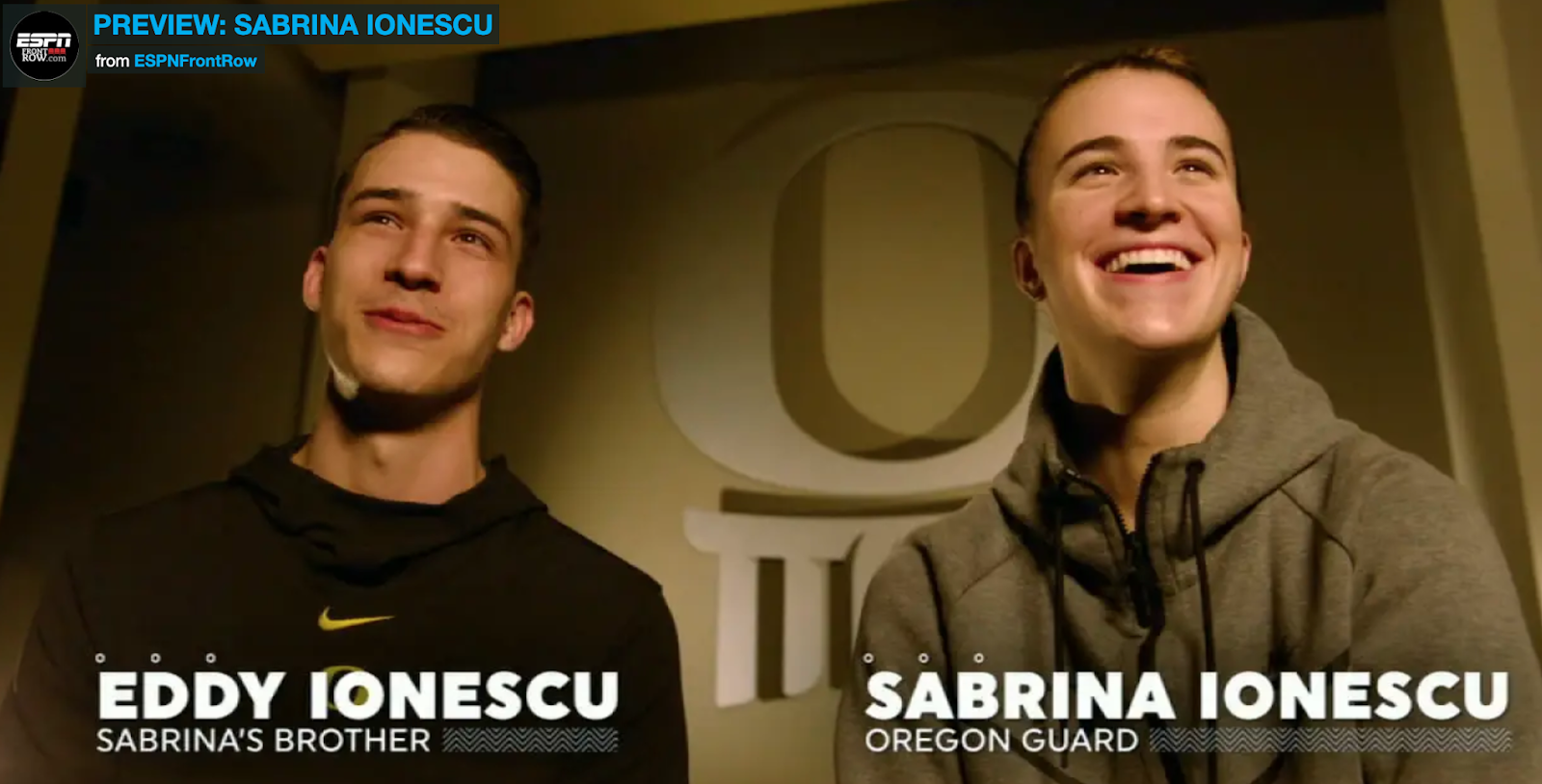
2. Sibling Support. It's uncanny to me how many have a sibling, (in particular for women in basketball a brother) who they would join in pick-up games or unstructured practice. Tina Thompson, Cheryl Miller, Arike Ogunbawale, Ruth Riley and Sabrina Ionescu each credit their brothers (older and younger) as their favorite teammate. In tennis, I have wondered if you have Serena without Venus (and vice versa). In this instance, sibling rivalry is a good thing. As Cheryl Miller said about her brother Reggie "iron sharpens iron." He admits she's the best player in their family.

With female basketball players, games against or with their brother usually--not always—means they were competing against a player who has more muscle mass and weight. This can be a benefit when participating in all female competition (again, this is not ALWAYS the case but in general this is true of men vs. women. For example, most female tennis players on the tour hire a male hitting partner to help them get fitter, hitting harder, faster and stronger).

3. Great athletes play other sports. I would love to see Thompson on the volleyball court! Undoubtedly, the skills that volleyball demands—blocking, hang time, jumping and digging —must pay dividends inside the paint. 

My dad's take on this point is that professional athletes are great athletes—period. I agree and I also think that one can sharpen the saw physically and mentally by engaging in other sports. Not only does an athlete engage in different ways of competing (pace, time, mental focus) but they are exposed to other coaches—their style, philosophy and demands. Jack Swarbrick, Athletic Director at Notre Dame admitted his preference for recruiting two sport athletes. Why? "We find these men and women are usually stronger in one sport than another. They learn different roles on the team given those two paradigms." In an increased world of specialization, the case for the two-sport athlete remains viable and worth considering.


Do you understand my argument? Is it possible that all three commonalities are not necessary? Is anything missing? Discuss. Report back!

Photo Credits
Millers
Arike
Ionescu

Saturday, April 11, 2020

Checking for Understanding Part One: Honor

In Catholic tradition, parents are the primary educators of the faith. In light of current events, that task now extends far beyond religious education. Parents are now the primary educators of math, science, art and music. They are on the front lines—teaching their sons and daughters history, reading, foreign language—you name it. So for those thrust into this new role here's one tip: check for understanding. In the most informal sense, checking for understanding asks you to assume nothing. The goal of this exercise is to gain a sense of what a student knows, perceived and thinks about an idea, theory, word or term. This is the first in an on-going series I will refer to as with this goal in mind.  Today's topic is honor.
We teachers seek ongoing feedback to monitor and improve student learning vis a vi ongoing formal and informal input. Checking for understanding, otherwise known as formative assessments are generally low stakes, which means that they have low or no point value. For example, I seek a thumbs up, sideways or down. I use exit tickets and  a single word summary. I find these strategies helpful in moving the class along at the right pace. They also provide a safe space for student feedback and questions. Any questions? Let's begin...

Honor
To me, honor is a formal word, especially when used as a verb. The 10 Commandments call us to it. We ought to honor the Lord our God as one. Growing up, I was reminded of the fourth commandment on a regular basis. Yes, mom and dad, I know I am supposed to honor you both. I had a strong sense of what it meant to honor a person, a legacy and a culture and a creed. The question is do young people today, too?


According to "Conversations of Conscience: Helping Young Adults Make Moral Decisions" by Michael Sacco
Over a decade ago, the sociologist Christian Smith led a research team with the National Study of Youth and Religion at the University of North Carolina at Chapel Hill that examined the religious beliefs of over 3,000 American teenagers. Smith’s research shed light on the significant gap that exists between the faithful temperaments of the teenagers he studied compared to the generations that came before. When they reflected in their interviews about “grace,” they took it to be a character in a popular television show—not about God’s grace. When they discussed “honor,” they were almost always talking about taking honors courses or making the honor role at school, very rarely about honoring God with their lives or striving to live as honorable people. When they mentioned being “justified,” they almost always meant having a reason for doing something behaviorally questionable, not having their relationship with God made right.
I get to teach about honor because Eric Liddell, the subject of the movie Chariots of Fire uses the term often. Although students in Sports and Spirituality are not required to watch the entire Oscar award winning film, read about Liddell's life, his sacrifice and success and get a sense of his story in a clip "The Muscular Christian."
Liddell believes "to win, is to honor Him." He professes this belief after he shares with Jenny, his sister, one of the more beautiful quotes of all time.
I believe God made me for a purpose. He made me for China. But He also made me fast, and when I run, I feel His pleasure.
To give it up would be to hold Him in contempt. You were right. It's not just fun. To win is to honor him.
Amen. I ask my students "What does it mean to honor God? Have you ever thought about way you honor God?
Perhaps you can ask the  same questions I ask for my students of your son or daughter. Check for understanding. The video clip for "Chariots of Fire" might not resonate with a certain age group but if they are runners, or of high school age—with the right context—I hope a meaningful and rich conversation with follow.

I encourage you to teach about "honor" for I believe it's a beautiful way to live one's life. Honor involves respect, dignity and integrity. To honor a person or God asks for nothing less. 

Photo Credits
Powerpoint slide (I wish they spelled his last name right....)

Wednesday, April 8, 2020

The Fruit of Inspiration? Sports and Spirituality Symbiosis, A Bi-Weekly Resource for Athletic Ministry

Matthew Kelly, the founder of Dynamic Catholic says
One of the things I've written, and I say over and over again is that people don't do anything until they're inspired, but once they're inspired, it's almost nothing they can't do, nothing they won't do.
Do you agree? 
In my own life, I've seen inspiration prompt action. I can recall specific moments and memories when and where an idea was born. I can think back to that feeling of being inspired and how it mobilized a vision to a reality. While I would argue that inspiration needs organization and discipline, I think Kelly is on to something.

A friend I have written about many times, my classmate, author and motivational speaker Alex Montoya whose personal mission in life is to inspire others has done that for me in countless ways. His bi-weekly newsletter inspired me to create my own. 

The goal was to get ideas for integrating spirituality —>sports into the hands those working with student athletes. The intended audience of my free bi-weekly newsletter is athletic directors and coaches. The purpose of this "Symbiosis" is to give these leaders a quote to break open with others in the field, a prayer they might use for their team or for themselves and a book/podcast/movie recommendation to read/listen/watch! Sports and Spirituality Symbiosis: A bi-weekly resource for Athletic Ministry was born.

With this posting, I hope that you will pass this resource on to those who might need it. I realize there is NO shortage of online resources emerging right now. It seems that this particular marketplace is exploding. But as Mother Teresa said in 1986, "we are the best marketplace. We sell love." Ultimately, that's what I hope my words and writing will offer to all who read and build bridges with young people via sport!

You can read it here and subscribe if/as interested (see top, left corner)

Monday, April 6, 2020

Missing March Madness? The Women of Troy is worth watching

You win back to back championships—where do you go from there?

Imagine being the best of the best. You have something to offer people, but there's no place to do the thing that you love. You don't have any options. What can you do?
Today, women in sport are asking different questions than those posed by basketball analyst Doris Burke. While today's athletes wonder when and how they will return to their season and their sport, the USC women's basketball team as chronicled in the HBO film "The Women of Troy" lived through their own trying times and limited reality. For sports fans, all of us who missed March Madness and advocates of women in sport, this program is a must see. Here are but a few reasons why.

The Leading Ladies
I originally watched "The Women of Troy" because I wanted to learn more about Cheryl Miller. Many have said she is the greatest female basketball player of all time. Her talent is not to be underestimated nor does it go unappreciated. She is however, but one of several stars in this show.

Pam and Paula McGee are identical twin sisters. One is outspoken and flamboyant, the other is staid and calm. One will speak and the other will finish her sentence. Without the two of them, Miller doesn't go to USC. 

The McGee's recall that memory. Paula said, "she had verbally committed to UCLA to which I told her 'You'll never win a championship because you got to come through us. You'll be Parade All American, you'll be the number one player in the country but you have only got one problem. You're looking at it'." Pam added,  "We number two in the country. We're trying to do something special." Cheryl responded to her with a question and a noteworthy concern. Pam recalled that exchange. She said, "Y'all two are All-Americans. How are we going to all play together?" to which I said " You can play two years with us or two years against us. It might be your game on Monday. Her game on Tuesday...." 

Though I have mad respect for Cheryl Miller, Cynthia Cooper emerges as the woman I admire the most. Her personal background and journey from Watts to USC, to Italy and beyond, her moxie, talent and honesty add a valuable chapter to this story. One of my favorite moments is when Cooper admits "there was definitely some friction (with Cheryl Miller as her teammate), but there's nothing better than playing with the gifted and most talented player ever to play in women's basketball." 

Her testimony confirms what everyone should know: The Women of Troy didn't win because of just Cheryl Miller. Every great team is comprised of individuals who know their role on the team and love their teammates for their role on it.

This is confirmed in the story shared by Juliette Robinson. She said, "
Cheryl wore number 31. When she came to SC she wanted 31 but I wore number 31. I took my jersey off  and I gave her my number. I said "Let's do this!" I had to wonder how many players would be willing to do that...and if that might not be the recipe toward a winning team.
A Different Era
I read an unsettling truth about Title IX often —although the federal civil rights law increased the opportunities for females in the work place, education and in athletics, an unexpected consequence is a decreased number of female head coaches. Other than Geno, every coach on the sidelines in "The Women of Troy" is female.

This truth was self-evident for every female coach featured in the film is unlike any other. The diversity of race, age, and style is both intriguing and inspiring. I encourage you to name your favorite. Though it's hard for me to ever go against Muffet McGraw— the woman who has the Irish to two national championships—Sonya Hogg, head coach of Louisiana Tech emerges triumphant over the great Pat Summit. How I wish Pat were alive today to defend herself! 


In the Review: HBO’s Women of Troy is a compelling look at the story of Cheryl Miller, USC, and women’s basketball overall Andrew Bucholtz writes, "The Hogg interview is particularly notable for illustrating some of the challenges women’s teams were facing at the time, from her comments on wanting the Louisiana Tech team to be called the Lady Techsters rather than the Bulldogs (so no one would call them bitches) to her remarks on their sleeved uniforms (so no one could see and comment on their bra straps)." 

As a sports fan it was hard not to delight in seeing current Baylor coach Kim Mulkey as a Lady Techster! Mulkey, who played for Hogg said “That lady can sell ice to an Eskimo.” I have a feeling that apple doesn't fall far from the tree.


Linda Sharpe, head coach of USC had her team play the toughest schedule they could early in the season so they could  learn from it and compete at a high level. Under Sharp, Miller said, "practice was pure competition every single day...to the point that the games almost seemed easier than the practice."vHard to argue against that philosophy as Sharpe led the women of Troy to back-to-back Championships in 1983 and 1984.

BC
The Women of Troy paints a valuable picture of women's hoops Before Cheryl. I have long believed a director's efforts and decision to include historical footage chronicling the history and development of the game is never in vain. 

This program shows how women in basketball once played exclusively on one side of the court. The assumption was that a full court game was too demanding for a girl. 

Uniforms for both men and women have come a long way. I can't imagine playing basketball in a skirt but that doesn't abhor me in the way it might for some other female athletes. I loved playing tennis in a skirt.

I had no idea that 
1976 was the firs time women's basketball was in the Olympics. Team USA took silver. It should go without saying, when Cheryl played in the 1984 Olympic games in Los Angeles, the US took gold.

Miller: one “bad mother f***er.”
The talented and insightful Doris Burke describes Cheryl Miller with those words. They don't appeal to me; I understand the sentiment but I do not believe they resonate with the spirit of Cheryl Miller. I would use that term to describe an athlete who plays mean and dirty. He or she is indignant and disrespectful to those around them.

Yes, Cheryl is flamboyant in her playing style. She admits "I wasn't just a showboat, I was very good at being a showboat." She said those words with such dignity, I laughed.

If given the chance I would 
describe her as iron. After all, when asked about her brother, NBA Reggie Miller, Cheryl—his older sister says, "He was my best friend. We were just one year apart." She added "Iron sharpens Iron. That's what we did for each other." Looking at the footage of both Millers in action, I believe it.
Cheryl Miller once scored 105 points in a single game. Her high school team defeated their opponent 179-15. I have wondered why that score was even allowed. Maybe her coach wanted to see what she could do. Unfortunately for basketball fans, that fullness of that question never gets answered. Miller, the Trojan's all-time scoring leader, played that one extra pick-up game in an era before ACL surgery was a possibility. (For those who have sustained a serious injury, those words may resonate with you!). Her career and basketball history took a much different turn.

The Bridge Builders
HBO lists "The Women of Troy" as an "illuminating tale of the historic and transcendent USC 1980s women’s basketball team, this film explores how the Cheryl Miller-led Trojans changed women’s basketball forever with their up-tempo style and superior athleticism en route to winning consecutive national championships, and ultimately influencing the establishment of the WNBA."

I would add but one insight, as stated by the Women of Troy. The McGee sisters said "
Our team was special. We were the bridge builders. We laid a bridge for the league, the WNBA to come behind us. We set a standard. We showcased a level of talent everyone wanted to be a part of.  We did our part to give these kids to pursue an opportunity of playing professional basketball." That truth makes this wonderful program worth watching, celebrating and discussing further.
Female coaches, I urge you to share this special with your team. It explores the very best of the dynamics of a female team that worked hard, worked together, understood the role of each part to the whole and made a dream come true.

I can't tell you how many people have told me they miss March Madness. This program isn't a substitute, but I guarantee what you will learn thanks to the work of Allison Ellwood will help you appreciate the game in the future, even that much more.

Photo Credits
The Crew

Cheryl standing 
Poster
In the basket
McGee Twins

Friday, April 3, 2020

One Cure in the Time of COVID-19: Walking

In spite of the fact I still watch Patrick Mahomes and Russell Wilson crushing it in the gym, I haven't been able to lift a weight, pull a stretch band or even swing a golf club (or putter). I am still struggling to find a routine to each day. Every self-help guru, every happiness expert, even my virtual pastor has suggested that creating a schedule is essential. However, not all is lost. After reading for 30 minutes in the morning, I put on my sweats and sneakers and I head out the door for my morning walk.
Pope Francis walks the nearly deserted streets of Rome in late afternoon on March 15
Sometimes I walk with with a friend. I've got the socially distant requirement down. We maintain a gap of six feet, walk single file when necessary and journey together. Other times, a friend will call to talk and walk. We plug in our headphones, and I have suddenly and virtually taken this person on the road with me. It is spring and I love being outside. The company I keep is as restorative and  refreshing as the steps I take. I continue to listen to my favorite podcasts and I have found new ones. Although I'm a visual learner, my auditory processing is gaining ground! Every once in a while, I simply walk in silence. This becomes a moving meditation—I walk and I pray. It might possibly be the most important part of my day.

Mother Teresa has said "the fruit of silence is prayer." And there is no greater time than the present for prayer. We need it; the world beckons. If you are like me, you might take more than one walk a day. Let one of those be your prayer. 
In the article "The Walking Cure" Michael Rossmann, SJ states "walking has a surprising number of parallels with the spiritual life." His words remind me that though walking might feel like one of the few options for exercise available to us right now, it offers gifts—spiritual ones—worth considering.

He adds, "I
’m far more open to pleasant surprises and simple beauties while walking and am able to change my plans completely." Just this morning, I took delight in the Pine Street garden—an urban collection of succulents and plants that hang from a chain link fence on a busy San Francisco street. I have driven by it no less than 1,000 times. By walking, I stood before but a few of Ireland's 40 shades of green up close and personal.

I have always been grateful for the gift of walking. I was able to accept that I could no longer run because walking is a viable and worthy option. I also know that there are people everywhere for whom walking isn't. 
During these times when it is easy to recognize and remember what we cannot do and where we cannot go, let us give thanks for what we can. As the world awaits for a cure for COVID-19, let the walking cure heal our hearts, minds, bodies and souls.

I encourage you to read Rossmann's editorial. You can find The Walking Cure here 

Photo Credits
Pope Francis walking prayer