Thursday, July 26, 2012

What the British Open Taught Me: Some We Win, Some We Lose

It was both exciting and…..what’s the word? It was dramatic and yet tragic. Watching the final round of the British Open on Sunday, July 22, 2012, I was left with one question: Did Ernie Els win or did Adam Scott lose? You might be thinking the answer is simple: “yes.” But I want to explore the question again…
Scott, the 32-year Australian golfer played his final 18 holes with a 4-shot lead over Brandt Snedekker and Graeme McDowell, his final round playing partner.  Els was 6-strokes back and 5-under par. It was Scott’s to lose—so to speak—and he did.

Similar to the 2012 US Open, I was hoping that Sunday’s leader would force a play-off rather than reveal who was the winner and who was not. As Scott’s 8-foot putt curved around instead of falling into the final hole, I wondered: to what degree does Scott’s loss take away from Els’ win. Again, did "The Big Easy" really win?
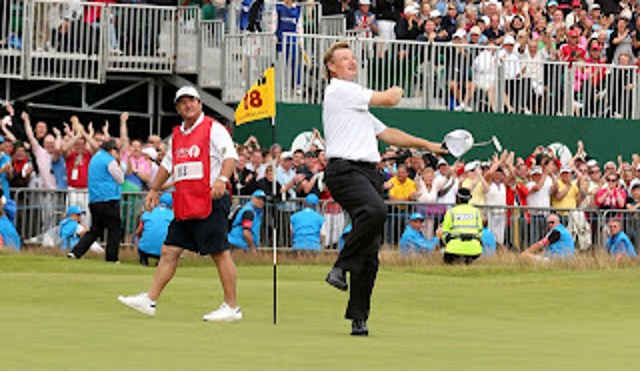
Els was one of the few contenders who shot under par on Sunday. Looking at his long putt from across the green on the on 18th hole, one couldn’t help but wonder for a brief moment if a victory was in store. For some reason however, the lingering feeling that sat with loyal fans at Royal Lytham-St Anne’s and me was different. It was a one-man loss / one-man win. For Adam Scott’s four bogeys on the final four holes, we had Ernie Els’ four birdies.  Is that enough evidence?

Look to the golfers and you won’t get an answer. Scott was remarkably calm and poised. I expected tears like Andy Murray’s after his Wimbledon final loss or a silence like the New England Patriots’ locker room. But no, Scott communicated his failing, especially on the last four holes with disappointment, but it wasn’t palpable. He acknowledged his mistakes, but without a wince. He looked the camera in the eye and kept his chin up. Did he lose?

Erine Els said again and again how badly he felt for Scott and how sure he was that Scott would have his moments.  He assured him that just about everything that can happen in the game of golf, I've gone through," said Els. "I've done what Adam has done. So to sit here with the Claret Jug is crazy."

I began to wrestle with this question as it applies to life. This idea is much different than winning the battle but losing the war.  No, this is about how we achieve a goal…how we meet the outcome.  In life we win and we lose, but how we do that varies. 
Sometimes we lose because a better opponent trumps us. We are clearly outmatched, outsized and outranked. At other times we simply do not win, not because we are not the worthy opponents, not because we are lacking in ability or spirit and not because our strategy failed. We don’t step it up at “the” critical moment. We fail to succeed; the end result is a loss. It is tough to lose, but the irony is that it’s also tough to win at this moment. 

I think that might be why we have a word for a great victory; it is a triumph. It is not something to be taken for granted.  A great victory leaves the athlete and the spectator with a sense that both teams or athletes played their best and fought until the end. One had to win. The scoreboard will indicate a winner, but to some degree the game was raised to another level because of the path to victory. 
The final round of “The Open Championship” revealed a different facet of life. Elections are won, and others are lost.  Relationships, jobs, and even wars are subject to this dynamic.  It is a tough perspective on life, but it also reveals quite a bit about one’s character.  Adam Scott and Ernie Els could not have been more grace-filled and respectable. In that way, both men won.  Both are champions and Sunday was a triumph for golf.

Saturday, July 7, 2012

Pump-Up Songs Reveal Soul & Spirit

Every semester unbeknown to my students, I conduct an informal social experiment.  As they enter the classroom after lunch, the most “chillax” time of the day, I play a sports pump-up song through the speakers. NB: a sports pump-up song is not to be confused with the most inspirational sports song. 

I start with Whomp (There it is)….Tag team back again…. followed by Zombie Nation’s Kenkraft 400 (Sport Chant Stadium Remix) made famous by the New York Yankees rounded out by the latest and most popular “Jock Jam.”  
I pretend as though I am preoccupied with some paper work.  What they don’t know is I am looking to see who reacts and responds to the music.  I want to know who are the students that hear the beat and can’t help but shake it.  I love these kids.  I love their enthusiasm and the fact that they can lower their inhibitions for just a bit. These kids have got soul.  What does that mean?

Soul is spirit.  There is a life pulse in these students—something I do not take for granted.  In "The Holy Longing" Ron Rohlheiser writes: 
First of all, it is the principle of energy. Life is energy. There is only one body that does not have any energy or tension within it, a dead one. The soul is what gives life. Inside it, lies the fire, the eros, the energy that drives us. Thus we are alive as long as there is a soul in our bodies and we die the second it leaves the body.

It is interesting that sometimes when we use the word soul, and think we are using it metaphorically, we are actually using it in a strangely accurate way. Thus, for example, we speak of "soul music.”  What gives music a soul? This can be understood by examining its opposite. Imagine the music that you so often hear in airports, supermarkets, and elevators. It is simple filler, soulless. It does nothing to you. It does not stir your chromosomes.  Certain other music docs and that is why we, precisely call it soul music. It is full of energy, eros, and all the things that eros carries-desire, disquiet, nostalgia, lust, appetite, and hope. Eros is soul and soul gives energy.
But the soul does more than merely give energy. It is also the adhesive that holds us together, the principle of integration and individuation within us. The soul not only makes us alive, it also makes us a one.
At every one of his concerts, my favorite musician Bruce Springsteen asks a crowd of 20,000 adoring fans “Is there anyone alive out there?”  He doesn’t need to beg the question; it’s a rhetorical one.  But he does.  And guess what the response is like.
And I think music is a critical force in making us one.  It can unite a community that is grieving.  It is used to mark celebration.  I truly believe it is the art form that can bring life and energy to humanity in a way that nothing else can. Music makes us dance, sing, understand one another and ourselves in a profound way.  Springsteen concludes his latest album “Wrecking Ball” with the song “We Are Alive.” 
We are alive
And though our bodies lie alone here in the dark
Our spirits rise to carry the fire and light the spark
To stand shoulder to shoulder and heart to heart.
Indeed, "the soul not only makes us alive, it also makes us a one." Perhaps I have more than I thought invested in my wee social experiment. 

And as the “sports pump-up” songs come to a close, I conclude my social experiment with a poll: You’re in the crowd at your favorite sporting event.  Which of these three songs is going to get you and the team the most fired up.  The winner?  Another social experiment…..party people!!

Photo Credits
The Boss 

Soul Music
Sports Jams music 

Thursday, July 5, 2012

Yesterday's Weight Room Meets Today's Resources

When you were in high school, did you lift weights on campus? Did your school even have a fitness center or training room? Have you seen the state of the art equipment and facilities available to today’s student athletes

Weight training at my high school—Carondelet—was relegated to a short rotation in PE. I think we had a few free weights; nothing more than 10 lbs. We did have a trainer, but her office was a converted dressing room behind the auditorium stage. Carondelet alumni include two Olympic champions and a host of other great female collegiate athletes. Across the street at De La Salle, I remember that the weight room was compact and it was full. It was also a royal sweatbox.  Guys should have called it “the lodge.”
Last summer I accompanied eight students on a summer service Immersion to Tacoma, WA.  By day we worked at L’Arche farm with developmentally disabled adults and by night we slept on the floor—excuse me, the mats in the wrestling room at Bellarmine High School. After a long day of working on an organic farm, believe it or not, working out was a welcome treat. But this wasn’t just any treat. We had access to Bellarmine’s brand new 4,528 square-foot, state-of-the-art training center.
Looking at their spacious facility with the latest equipment, I thought how far things have come.  For example, their website reports, “the opening of the Fitness Center significantly improves the workout experience for members of the Bellarmine community from the standpoints of health and fitness, convenience, and aesthetics. The new center nearly triples the amount of workout space available to students.” Bellarmine made a huge commitment to fund and build this valuable community resource and they know what it adds to their campus.  “The goal of the center is to provide a healthy, positive and safe environment that will build and strengthen the mind, body and spirit and the benefits will be felt for years by countless members of the Bellarmine community. “

The good news is that this weight training and an increased emphasis on personal fitness is not gender specific! Bellarmine is co-ed and Notre Dame, all girls high school in Belmont, CA, has instituted a new requirement this year that all girls visit the strength and conditioning room at least 25 times before their team starts its season.  Indeed, it is a core element of the school’s athletic program (Catholic San Francisco).

I began to wonder, Do students have an increased access to outstanding spiritual resources as well?  What innovative religious programs might students be excited about today? I am happy to report that I can easily name two. I know there are many others—and I welcome your input!

The first is YOUCAT.  YOUCAT is short for Youth Catechism of the Catholic Church, which was launched at World Youth Day 2011 in Madrid (another wonderful event and resource for Christian youth). It was developed with the help of young Catholics and written for high-school age people and young adults. 

Why is it appealing and better than other resources of the past? For one, YOUCAT is meeting young people exactly where they are—which is anything that pertains to the self. Look at the name: YOUCAT; YOU are directly addressed.  It’s website says, “YOU are challenged by faith, it's YOUR catechism, make it YOUR own, it's YOUR faith that has been given to you, so make it yours! This is about YOU, YOU are wanted, YOU are needed.”

Second, the images in YOUCAT show young, positive, natural and authentic people in all walks of life. The photos were taken not by professionals, but were made by young, enthusiastic amateurs. YOUCAT encourages readers to send their favorite photos of faith and life (office@youcat.org) with the idea that a talented photo may make it to the next print edition.
Its overall graphic format is light years easier to use than the traditional Catechism which may require instruction for navigation. YOUCAT’s graphic format includes Q & A, highly readable commentary, summative definitions of key terms, Bible citations and inspiring quotes from Saints and others in the margins. What's more, because YOUCAT is keyed to the Catechism of the Catholic Church, people can go deeper. It broadens the definition to youth to include not only to those young in age but also to those young in faith. In that sense, it’s invitational.  “When faith is young, questions are the same, whether you are 15 or 50.”
The second resource is Bible Atlas a website that features maps of the Holy Land, where St. Paul traveled, and more.  It allows viewers to see the cities names in the Bible quite clearly. For example, a student who is reading Joshua:12 can scroll down to that book of the Hebrew Scriptures and the towns or places mentioned in that verse will be highlighted. This rich visual resource will give students a deeper appreciation of the distance Mary and Joseph had to travel from Nazareth to Bethlehem for the birth of their son. 

I’m curious to know how the faith lives of young people have benefitted from these two spiritual treasures. The results of athletic discipline are easier to measure. At Notre Dame, “We found if the girls got 25 workouts in, they tended to be injury free. They went through their season with no injury. Any workouts they got over 25, the girls who got between 25 and 50 workouts saw an improvement in their athletic performance.” I welcome input on the spiritual benefits as well.

Photo Credits
Bible Map

Bellarmine's Fitness Center
YOUCAT
Sample YOUCAT

Monday, July 2, 2012

A Call for Change in tradition (small t) in the Church and at Notre Dame

I had no idea the changes in the tradition of the Mass would give me pause to think of another tradition I hope will change—the words of the Notre Dame Fight Song.
Last week I started to believe that after seven months of reciting the new responses in Catholic mass, I had it.  The changes to the Roman Missal stopped feeling so “new.” However, a few days later at a small daily mass, I heard my own mistake loud and clear.  As the congregation replied, “it is right and just,” I kept talking: “it is right to give Him thanks and praise.” I was humbly reminded that change is difficult. But, it can also be valuable and at times, is necessary.

Tradition can remain tradition with change. The Notre Dame faithful may resist my proposed change and may fumble a few times after its implementation, but I believe it too is valuable and necessary.

The new Roman Missal implemented in Advent 2011, served as the perfect opportunity to discuss “Tradition and tradition” with my students. Perhaps they rolled their eyes as I made another nod to grammar and semantics. We make distinctions between Catholic and catholic, Saints and saints. Was yet another upper and lowercase nuance a worthy Catholic tradition?  Was I making something out of nothing?

The definition of tradition in the glossary of “Catholicism” is “Both the process of “handing on” the faith and that which has been handed on. Tradition (uppercase) includes Scripture, the essential doctrines of the Church, the Eucharist and the other sacraments, and so forth.  Tradition (lower case) includes changeable customs, institutions, teachings and practices.”


Tradition, also known as Sacred Tradition remains constant.  And, in a secular context, we think of tradition in much the same way.  Tradition is an act, ritual or custom that is passed on from one generation to the next.  It is often respected and appreciated.  It must be explained, practice and taught. To learn about tradition with the lowercase “t” may seem a bit schizophrenic. If it’s changeable, then it is tradition.

Once again the Roman Missal served as a worthy example to explain this concept. Msgr. Anthony Sherman, executive director at USCCB Secretariat of Divine Worship says “It is the book that provides us with prayer text. It serves as a point of unity that keeps us all together, presenting the prayers that are used around the world, in many languages, during universal feasts or holy days.”

In 2002, John Paul II issued a re-examination of the missal.  It was inspired by the fact that the Church now had the lived experience of praying the “new Mass” for 25 years. “This also provided an occasion to add new prayers, especially where the same oration was used more than once, and to make minor corrections or improvements in many of the prayers. Finally, prayers for the saints added to the calendar since 1975 could be incorporated into the Roman Missal (Catholic San Francisco).”
The changes made may have been just a word or a phrase, but they are not insignificant. I now stop to think of the new response I am called to give. On the other hand, the Mass did not change. And the overall spirit of liturgy as a celebration of the Eucharist remains. Tradition was in concert with tradition. 

I was largely pleased with the product. I understand why we made the changes.  Some are even beautiful.  But the one area that I cannot reconcile is the absence of inclusive language.  Most notably, during the Nicene Creed, we say: For us men and for our salvation He came down from heaven.

I believe the Church had perfect opportunity to say “yes” to language that is not limited. Our response could have been modified to “For us, and for our salvation.” Or even “for humanity and its salvation. “In the 25 years that the Church has lived with the experience of the “new Mass” we have only heard more requests for the inclusion of women, be it on the altar or in other leadership roles. I wish that a change featuring inclusive language became part of our tradition.
And if there is one place that knows and celebrates tradition, it is my alma mater, the University of Notre Dame. We are united by traditions distinct to each dorm, by traditions that shape football weekends, others that characterize graduation—a last visit to the Grotto and even traditions to carry as an alum—wearing of plaid pants and more.

I received a letter from the alumni director Dolly Duffy calling attention to the fact that we are now celebrating 40 years of coeducation at Notre Dame. 

Duffy, the first female director wrote, “The University is asking women how they would like to celebrate the anniversary.”  My request is clear—please change the fight song to be inclusive of who the student body has been for the past 40 years.
I remember as a student in Farley Hall discussing with several of my friends that the Fight Song should feature inclusive language. In fact, at every football game, this group made a point of changing the words from “While her loyal sons go marching onward to victory” to “While her sons and daughters go marching….”  The syllables fit. It sounded great. It wasn’t overly contrived.

Over 15 years later, I was reminded that the words have not changed when I saw “The Shirt: 2010.”  The back reads “Rally Sons of Notre Dame.” A friend turned to me and asked "Why doesn’t it say sons and daughters?”  I didn’t know. We guessed that because it’s a football shirt, the language is fitting.  My heart of hearts believed otherwise.

Duffy concluded her message noted “we have been blessed by the talents and contributions of amazing women. Father Ted Hesburgh’s experiment has definitely succeeded.” I hope with the lived experience of 40 years of women at Notre Dame that another experiment launches—a move toward inclusive language at Notre Dame and in the Church.

Worth Noting: The University of Notre Dame changed the lyrics to their fight song, the "Notre Dame Victory March", in June 2022. The change was made to recognize the 50th anniversary of women being admitted to the university. 

Photo Credits
Cartoon-Roman Missal

Roman Missal
The Shirt: 2010

Touchdown Jesus
ND Shoulder to Shoulder
ND Tradition

Friday, June 29, 2012

Unmatched: Why Chris Evert is a Role Model for Women's Sports

I went to purchase a pair of heels for work. As I was browsing, I found a pair I liked. I held them up to show my friend who said in reply, “they’re nice, but I want a pair of shoes that are “sexy.” I put them down and wondered, “when did feminine get replaced by sexy.” 

The sexualization of young girls and women is not a new topic.  Plunging necklines, shorter skirts, higher heels than I once thought possible are the norm. When my co-worker found a padded push-up bra for sale in the girls’ section of a department store, I confronted a new low. It was marketed for an 8-year old girl. Again, I asked where is a pretty dress? Or is hot the only way to go? Is there a woman out there who models feminine and pretty instead of hot and sexy?  I would love some answers. 

It seems I found a few in ESPN’s 30 for 30 "Unmatched," a documentary that spotlights two tennis greats Martina Navratilova and Chris Evert from their teenage years on.

As I watched “Unmatched” I was struck by a number of things: the magnitude of their rivalry, the depth of the friendship and just how feminine America’s sweetheart, Chris Evert was. Overtly, she was not presented as a sex symbol—although I wonder in today’s world if she would be.  No she was distinctly, innately and tremendously feminine. And for this very reason, I think Chris Evert is a great role model for women’s sports.
Chris Evert won 90% of her matches, including 125 straight on clay, the longest winning streak on any single surface. “For 12 years from 1975-1986 only Chris Evert and Martina Navratilova was the top-ranked player of the year.” She won 18 Grand Slam championship titles and reached more Grand Slam singles finals than any player, man or woman, in the history of professional tennis.  I love that she was Sports Illustrated’s 1976 Sportswoman of the Year.

Evert was a dominant tennis player, but “played like a woman.” She was a master from the baseline. Her strength was her ability to draw a player to the net so she could launch her lethal passing shot. Her serve was incredibly consistent and she was always fit. I love Serena Williams’ style of play because she is so tremendously athletic. She hits for power. Her serve is killer. She is very aggressive.  I don’t mean to say that women cannot play like Serena, but many can’t and I never did. I believe Evert presents a style that many females can identify with—she played a calculated game with her strength; strength that played to her build and her feminine nature.
Her look was tremendously fresh and feminine.  I looked with fascination at the many hairstyles she featured for 17 years in the spotlight.  From the classic ponytail with a ribbon, to a bun, a perm in the 1980s or a feathered hairdo held in place by a braided headband, Chrissie could have been one of my fashion plates. Her tennis dresses were pretty yet fashionable. From the lace one piece to her matching yellow dress as Martina’s doubles partner in the Wimbledon finals to the later years with her colorful Ellese skirts, she was always dressed to kill.  Not one outfit was inappropriate or even borderline un-classy.  Chris was an example of how women are beautiful.

But as we know, looks aren’t everything. And Chrissie is a worthy example for more than her physical self.  Many women have been discriminated against because they are too emotional.  Chris Evert however was anything but emotional.  She was cool and could always keep a straight face. In “Unmatched,” Martina said, “Chris was so strong and so tough mentally. She didn’t look the part, but my God, she was as tough as they get.  She was one of the greatest competitors ever.  She motivated me to play stronger.” Evert’s a wonderful example that female athletes need not let their emotions get the best of them.

As mentally tough as she was, Evert had a soft side that speaks to the caring nature of women. In the 1976 Wimbledon finals, Martina was losing big time in the first two sets.  In fact, she completely whiffed an overhead.   Shortly thereafter, standing at the net, Martina guessed wrong that Evert was going to hit her shot cross-court.   The ball hit Martina, which doesn’t happen often in singles tennis.  Martina said, “I was mortified once again.”  Chris immediately pet Martina lovingly on the head and asked if she was okay.  The two laughed about it.  It was a very tender moment.  Martina also thanked Chris for totally accepting her for who she was.  She said, “Chris was gay friendly before it was okay to be gay friendly.  She was always supportive of me.”
“Unmatched” deepened my respect for both women in different ways.  I was saddened by the reality of many challenges Martina faced, one of which is contrary to the point of this posting.  Martina was anything but feminine. But in her own way, she too is a wonderful role model for women in sports (another blog posting?). 

In spite of it all, Chris Evert remained true to who she was in a simple basic way. She was a great female athlete. She was feminine and fierce, pretty and poetic on the court, unemotional and yet caring. She reminds me that as a female, you need not be a sex symbol. You just need to be yourself, no padded push-up bra required.

Photo Credits
CE and MN serve

Lace Dress