Thursday, June 14, 2012

Matt Cain: Together we are Giant...and Perfect.

I love the number 22. I can’t think of a more fitting pitcher to have executed the 22nd perfect game in Major League Baseball than the San Francisco Giants’ own Matt Cain. The numbers that characterize the longest tenured Giant (at the age of 27) are deceiving. Thanks to a commanding 8-2 record this season, #18's lifetime record (77-75) is back over 500. I can think of innumerable games that have resulted in a loss because of a lack of run support from the Giants. Fortunately, last night was different. The Giants scored a season high 10 runs for him.  They picked him us as he picked up all of SF today. For once, all the numbers add up. 0 Runs, 0 Hits with 0 Errors = 1 perfect game.


And with it comes a great lesson for sports and spirituality. Matt Cain achieved true greatness on Wednesday night, but I can’t see his accomplishment without recognizing that he did not do it alone. None of us can do it alone. I would like to argue that this is why we need both authentic religion and authentic spirituality in order to live a life of faith.

When I caught the highlights, I couldn’t stop the tears from flowing when I saw Blanco’s incredible catch in the 7th inning. 99% of the time that hit is a triple. He was positioned close to the gap and made a great angle to the ball.  He had no glove left on the ball.  If you look up “web gem” in the on-line dictionary, you will now see Gregor Blanco.


When he caught it, he immediately turned to show his teammates on the infield that he made it. Blanco wasn’t looking for personal glory; no he already knew he was a part of something much greater—a perfect game in the works. Cain took his hat off to salute the right fielder.  When the two reconvened in the dugout they exchanged an embrace of gratitude. This is but one example that Cain’s feat was made possible with the hands and handiwork of others.

I would not be writing about faith if it hadn’t been passed down to me through my parents, grandparents and some great teachers.  I continue to learn the precepts of my faith through study, prayer and example. When asked what is my religion, I identify as a Catholic. Ask me about my spirituality, it’s Catholic too (heavily influenced by St. Ignatius. Ignatian Spirituality.  But please note, Ignatius, the founder of the Society of 
Jesus, the Jesuits, always points us back to Him.). I am incomplete without both. Religion guides what I do and spirituality characterizes how I do it.

Many people find spirituality more appealing than organized religion because of its free form and personal nature. The beauty of the spiritual life is that is a reflection of who we are and how we live. It need not follow any order or ritual, tradition or even other people. This is inviting but it can be tricky. It can go unchallenged. It can become undisciplined and isolated. 

Religion on the other hand provides a community of faith in the way that spirituality does not. It is defined by tradition and ritual. It is passed down from one generation to the next through this order. Yet, many who identify with a faith tradition find that while some religious teachings do reflect who they are and what they believe, many do not. This tension too often leads people away from organized religion rather than working from within. What is the answer?

I believe spirituality and religion are two feet of the body of faith. Sometimes we lean more on one foot than the other, but I firmly believe both are necessary for the journey!

An author I respect and admire, Andria Trigiani (who is not a theologian or overtly spiritual/religious person) wrote “There is no one path to learning faith. You use the tools you have and if that includes gathering in community, then that’s for you. Some people go to the gym and others put on a pair of sneakers and run as far as they can go. Both build the body and so it goes with the soul, the path to faith is personal.”


While I appreciate the running analogy, ultimately, I disagree. I really think you need both.  Religious without spirituality is bone dry. Spirituality without religion is selfish. That is a VERY strong word, but ultimately, it only benefits the self.  I think back to Barry Bonds’ singular accomplishment in achieving the home run record. It was exciting but it wasn’t transformational. I don’t think there’s a member of the Giants on the field last night who didn't wake up today saying “I was a part of something truly magical last night.  Matt Cain did it.  We did it. Go Giants!” You may disagree. Many do.

Matt Cain’s achievement was made possible because of Melky’s Cabrera’s catch at the wall in the 6th, Buster Posey's efforts from behind the plate..and the list could go on. But it was also made because Matt Cain is a work horse. He is talented, committed and fierce. This game was in the making for many years. His perfection was seen on June 13, 2012 and will be celebrated for weeks, months and years to come. I believe our perfection or ultimately our salvation is no different. 

Credits
Special Shout out to Marc Rarden—the lucky dog who was at the game for first hand insight and the photo featured here as well as to my co-director/producer, Sean Lawhon for additional input.

Sunday, June 10, 2012

Casey Martin: Proof that golf is the greatest game ever played

What a difference 14 years makes…and doesn’t make.

Fourteen years ago, I’m not sure I could name 10 athletes who are devout Christians.  Is it just me, or is the list growing? As fans get more comfortable (or not) with the likes of Tim Tebow or Josh Hamilton, Jeremy Lin or RG3, I think back to the pioneers in this field—AC Green and Kurt Warner.  I wasn’t overly comfortable with PDF-- public displays of faith.  Overt gestures and award winning thanks to God didn’t sit well with me.  And then I heard Casey Martin speak on KNBR.  The full story is here…"What he said and how he said it."  What a difference (x) years makes…..


In 1998 the Olympic Club Lakeside hosted the 98th US Open.  Among its contenders were two national champions from Stanford University—Casey Martin a member of the 1994 winning team and Tiger Woods, who won the individual NCAA championship in 1996. At the time, Tiger had won but one of his four green jackets.  Casey Martin on the other hand was better known winning the right against the PGA to use a cart during tournament play.

What a difference 14 years makes.

Today, Woods has won 73 PGA Tour events and has been world number one golfer for the most consecutive weeks and greatest total number of weeks. He has been awarded PGA Player of the Year a record ten times and he has won 14 professional major golf championships, the second highest of any player (Jack Nicklaus leads with 18).

After trying to make it on the tour from 1998-2003, Casey settled into a new role with the sport he loves.  He is head coach of the University of Oregon men’s golf and is hoping to leads the Ducks’ to their first NCAA championship golf title.


Today, Woods is seeking to gain his first major since the US Open 2008.  This four-year period is the longest drought for him since his 2005 Masters win (prior to that, he hadn’t won since the 2002 US Open).  People wonder, Does he love the game or does he love winning? A fair question.

Martin however is thrilled to be playing.  He made the cut by one stroke. According to US Today Sports, he said "I do stay close to the game, and even though I don't compete anymore. I decided that because it was a qualifier — it is the U.S. Open, and it's true that it's open to anyone who can qualify — I would go for it. And lo and behold I made it."

Tomorrow, they will join Stanford sophomore Cameron Wilson and Oregon State junior Nick Sherwood as they play their first practice round together at the Olympic Club.


People continue to look at Tiger with more disdain than affection.  We don’t know where to place him or how to characterize him.  Who is Tiger, really?  What is in store for the legend, the two-time Sports Illustrated Sportsman of the Year. 

And people will look at Casey with ever more respect and affection.  A friend admitted today, that in 1998, he thought it wasn’t right that Casey was permitted to drive the cart at the US Open.  Martin filed a lawsuit against the PGA who claimed it created an unfair advantage.  Fourteen years later, we look at the Supreme Court’s decision and wonder how we could have thought otherwise.  Making an accommodation for an athlete with a disability does not compromise the game.  It is ensures that justice is served.

What a difference 14 years makes...


The Disney movie "The Greatest Game Ever Played" is about golf. I used to roll my eyes at the over-dramatic title, but as William Simmons so eloquently states, “through great visual display credited to director Bill Paxton, we find out that this has much more meaning than a game.”

He adds "though the movie is about golf, it seems as though the sport is just the framework for what is really going on. What is really going on is a story of individuals being told they can't fulfill their dreams, because of age or social status." What unfolds, regardless of a conflict between a son's wishes and a father's demands and an English golf legend looking to bring the title home with the country breathing down his neck is what the title suggest is that a great game is being played.

Once again, golf has served as a framework in the life of Casey Martin. He never let a disability get in the way of his pursuing his dream. Obviously the dream has not died. Same venue, many of the same golfers….14 years later. I hope this year’s US Open reveals what will be the greatest game ever played.

Photo Credits
Casey Martin and Tiger Woods
Stanford Team

Coach Martin
Tiger
Golf Cart

Thursday, June 7, 2012

My Commencement Address: God's Dream for Us

I love graduation day. The pomp and circumstance of this special day in a person’s life always speaks to me. And in the month of May, I delight in hearing who will speak as the commencement speaker at various colleges across the country. 

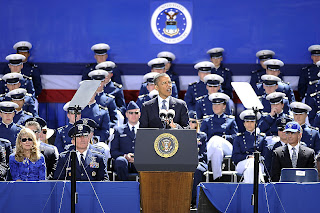
The debate of whether or not President Obama should have spoken at Notre Dame still looms with controversy even three years later! I was impressed to read that he spoke at Joplin High School in Missouri. Just hours after last year’s graduation ceremony, the school was destroyed by a massive tornado that claimed the lives of one graduate and 160 others. He also spoke at Barnard College and most recently at the United States Air Force Academy.


Imploring them to be part of the next great “American Century,” President Obama addressed graduating cadets and their families. “I see an American Century because we have the resilience to make it through these tough economic times. … And no matter what challenges we may face, we wouldn’t trade places with any other nation on Earth,” Obama said (Denver Post). I hope these young graduates rise to the challenge.

I love to wonder, if given the opportunity, what I would impart to graduates. Considering that I have concluded the last 12 years of teaching seniors with a common message, I know exactly what I would talk about: pursuing your dreams...with a twist. In fact, the final unit in my senior elective Sports and Spirituality is related to this very topic.  We study spirituality as God’s dream for us. 
|
Understanding spirituality in this way means “letting go and letting God.” It requires discipline, prayer, being open and total trust.  A very special guest speaker and friend, Frank Allocco, the head coach of De La Salle High School basketball, revealed how true this was in his own life.  In the article “Lofty Dreams and Buried Blessings” he said, "As a young man, I thought I had a clear vision of what my life should be, but God had a better plan. I just had to let go and trust that He knew the way…."


Because this humble truth is both beautiful and tremendously challenging, examples are a must.  We need to hear about the lived experience from others that we admire, love and trust—from Coach Allocco to your alma mater’s commencement speaker. We need assurance that the spiritual life, when lived this way may yield a dream akin to the pearl of great price. 

On the last day of class, I didn’t give an address to my students.  Instead I showed the NFL Films: Putting Our Best Foot Forward—David Ruffer.  I hope you watch it. The moral of the story is eloquent:
Monday through Friday, David Ruffer lives his dream by attending Notre Dame.  On Saturdays, he plays football.

“It wasn’t something I ever thought I’d be doing.  It’s greater than anything I thought would happen.” said Ruffer.

Maybe the best dreams in life, are the ones you never had... that still come true.
For those who believe, I think this is the perfect way of explaining God’ dream for us.    


Photo Credits
President Obama
Coach Allocco

Sunday, May 27, 2012

A Priest in the Pits: New Evangelization Comes to the Indy 500

Sunday may be the Christian Sabbath, but the work of Dario Franchitti and Glenn O'Connor at the 96th Indianapolis 500 kept this day holy in a unique way. A now three-time champion, Franchitti, "took the checkered flag after a rousing finish that rewarded an estimated crowd of 220,000 that braved 91-degree heat, one degree short of the hottest 500, in 1937." While he was driving and competing to honor the late Dan Wheldon, his friend and a fellow driver who died in crash last October, Father Glenn O'Connor was honoring God in a unique way. For one Sunday out of the year, Fr. O'Connor won't be found celebrating mass at his parish. No, this priest is in the pits...I had a chance to talk to him about his favorite other ministry.


As a body is one though it has many parts, and all the parts of the body, though many, are one body, so also Christ.
Father Glenn O’Connor may preach the words of 1 Corinthians 12 on Sunday as pastor at both St. Joseph and St. Anne parishes in Indianapolis but he lives the message as a member of a pit crew at the Indy 500. Every member of a race team has a very specific role, an important job to fulfill. And for the last 35 years, Fr Glenn has been contributing on the Indy speedway and in the Archdiocese of Indianapolis in his own unique way.

His formation in the pits parallels his formation to the priesthood. Fr. Glenn, 60, was in the seminary when he first began working as a member of a pit crew. His brother in law, Joe Flynn crashed his car and needed some help. Fr. Glenn has always loved racing, so to contribute to the sport and the community in such a critical way was and still is an honor. Both responsibilities have been sources of great joy.  In fact one has influenced the other. 

Father Glenn has brought his priestly ministry to the track in formal and informal ways.  Although he is not the official chaplain of the Indy 500, he is an active member of the Indy Racing League (IRL) ministry team
, which serves the spiritual needs of the open wheel community. And the demands of racing--traveling, pressure, injury, victory and failure—take a spiritual toll as well.  Fortunately, Father Glenn offers
 an early mass on race day.  He takes part in an ecumenical prayer service before every race, he has ministered funerals for drivers and their families and continues to spread the “good news.”  We sought to know what he has learned “in the pits.”


Your vocation has led you to many different ministries-what led you to racing and the priesthood?
As a native of Indianapolis, racing is something I grew up with. Interestingly enough, the same is true with regard to my vocation.  My father was in the seminary and although he left, he remained close friends with his classmates.  As a result, I was familiar with the life of a priest; all that my father learned had an impact on me.

In the 35 years you’ve been involved in auto racing, how has it changed?
Sponsorship has had the greatest impact on the sport.  There is so much more money involved, at least for teams that are sponsored. Those without corporate sponsorship subcontract pit crews, which is much more affordable.  I help out with that type of crew.

Before sponsorship, if a car crashed and a part was not available in your pit, teams would share parts.  Competition was much more open. Now, teams are more secretive with what they have—they are not as open to share. As a result, the sense of community has diminished.

Today’s drivers are much more professional. They can earn millions of dollars and are in tiptop shape physically and psychologically. These athletes are held to an even higher standard. Sponsors are not willing to back up drivers who aren’t good role models. They must be articulate and be good businessmen.  Brian Barnhart, the Chief Operating Office of the IRL will reprimand drivers for unsportsmanlike conduct, possession of drugs, etc. 


And over the years, how has your ministry changed?
One of the greatest challenges for me as a priest is to evangelize. But the best way to do that is to bring the Gospel to people—wherever and however. In the garage area, people come to me with questions, seeking confession, and so on.  Racers are no different than anyone else. They battle depression, deal with crisis and suffer illness and are in need of spiritual guidance. I have been doing this so long, people know who I am and what I do, so there is a comfort level. Ultimately my ministry hasn’t changed.

What’s been the biggest challenge for you as a member of the pit crew?
Every racing team has its own challenge—a lack of money, lack of an experienced driver, some teams are short on help, and others must work longer hours. Every pit crew faces adversity, but the most successful teams know how to handle it.


That sounds like a great analogy for our lives of faith. Do you mention auto racing in your homilies? 
Oh sure, my parishioners love hearing about racing.  I try to relate the Gospel to our lives and what we love.  Racing makes that easy to do.

Blessed John Paul II and Pope Benedict XVI have both emphasized the need for New Evangelization during their papacies.  "New Evangelization" is the call for Catholics to proclaim the Gospel in new ways. I like to think what Fr. Glenn is doing is new evangelization at its best.  We can meet Jesus' message in Scripture, in spiritual writings, or a conversation in unlikely places--even the Indy 500.

PHOTO CREDITS

Wednesday, May 23, 2012

Why Teach? Why Coach? What Do You Get Out of It?

What do I get from teaching? What do I get from coaching? The easy answer to the first question as this time of the year is “summer vacation.” But as I say “thank you” and bid farewell to the young men and women—students and athletes who have grown, learned, challenged themselves, excelled in the classroom and on the field this past year, I realize what I walk away with is something very simple, but profound.  I get a relationship.
I would like to thank Vince Tringali the late, legendary St Ignatius football coach for teaching me this valuable truth.  He said:
What you get from coaching is a relationship. And for some it only lasts a season. Still others ask or need more of you and it extends beyond. And with some, the relationship lasts a lifetime. One that does not end, even with this life.
A relationship is a gift. It is born out of opportunity and circumstance. It’s cultivated over time. It requires trust, care, concern, honesty, and more give/less take.

The fruit of a relationship with a student or athlete is unique. It cannot be prescribed, only described.  Ultimately, relationships are what give life meaning. And that simple truth should be of little surprise because God seeks a personal relationship with each and every human being.

Jesus came as one of us so we could understand what a personal relationship with God means.  He built relationships with unsuspecting people. He had them in the most basic, fundamental way--He was son, a cousin and nephew. He was a teacher and many of his students became His disciples. I also think He may have been a baller, but that’s for another entry. 
During this Easter season, we know the disciples felt lost and confused by His death and His reappearance over 40 days. They were unsure how to relate to Jesus in this new way.  Jesus responded in sending an Advocate, the Holy Spirit. He said to his beloved And remember, I am with you always, to the end of the age. (Matthew 28:19-20).

I met Jesus at a young age; I hope this is a relationship that lasts a lifetime.  I take comfort in knowing my relationship with Christ and with many others does not end, even with this life.  Even more, I am humbled by what I "get" from teaching and coaching.  The best part about it however is that what I "get" is also given....

Photo Credits
WCAL III