Sunday, October 31, 2010

WCAL Product: Pat Burrell

Sports Illustrated ran a humorous, albeit potentially sacrilegious piece prior to the 2002 World Series (yes, Game 6 still hurts). It featured a photo of a milk carton and on its side the Missing! campaign for kidnapped children. This one said: “Missing in the month of October” underneath two photos of Barry Bonds. In his prior post-season appearances, Bonds had performed so miserably in baseball’s sacred month, one could not help but wonder if the power hitting offensive machine was missing. Where did he go?

Unfortunately for the 2010 Giants, it seems that Pat Burrell could appear on our post-season milk carton. He is 0-for-9 in the World Series with eight strikeouts and has 19 strikeouts through the Giants' 13 postseason games. Much to his credit—enough that it became the focus of the article PAT BURRELL Struggling outfielder lost in sea of strikeouts. Jenkins writes, "Burrell was one of the first Giants to address reporters after the game. At times like this, a lot of players hide out interminably in the players' lounge, weight room or training quarters, but Burrell wanted to get it over with." I would like to think that Burrell took the higher road, because of what he learned as an athlete in the WCAL—Western Catholic Athletic League.

Burrell transferred from San Lorenzo High School to Bellarmine College Prep before his sophomore year. Bellarmine, an all boys Jesuit high school in San Jose was a member of the competitive WCAL, which he believed would give him the visibility he needed to be discovered by pro scouts and major college coaches.


A naturally gifted athlete, Burrell originally played football, basketball and baseball. As the Bells’ varsity starter at quarterback during his junior year, he competed against Tom Brady who played for Junipero Serra High School. Brady made headlines in January 2010 when he said "I think we're way overpaid as it is, all of us," Brady said Jan. 25 while making a Boston-based appearance for charity. "We get to go play football for a living. I love playing, and I'm very fortunate to play. … [The contract is] not really a concern." Did Brady have the guts to say this because of what he learned at Serra? That’s not for me to determine. However, I can say as much fun as its been to wear orange and black at school this past week, I know one religious studies class has undertaken serious conversations about the justice of athlete’s salaries and what it reveals about our society. I suppose a small part of us should delight in the fact that the two teams with the highest payrolls in Major League baseball are not in the Series. Rather, it’s the Giants at number 10 (with a payroll of $97,828,833) and the Rangers at number 27 (with a payroll of $55,250,545).

In “A Coveted Title, A Catholic League” I wrote about what makes this league unique. One may say all ten schools are “private” or their success lies in their indirect “open enrollment.” However, as a teacher and a coach at a flagship WCAL school, St. Ignatius, I am asked to model time and again the values we inculcate and to bear witness to the Good News of the Gospel of Jesus Christ. You can cite Brady and Burrell's transgressions, call me idealistic, even "Pollyanna" but if we don't believe our student athletes are experiencing something different--something greater, than what are we doing? Why are we here?

Our student athletes, like Pat Burrell may initially seek a WCAL school because they are "higher profile" but my guess is they leave with a sense of the “magis”—something more, of speaking the truth when it may be difficult and to own up to responsibility when it might be easier to be missing. They will also find a community of concern and a tradition of excellence that is larger than their success or their salary. Pat Burrell is the third Bellarmine alum with a World Series Ring. Along with Marv Owen ’26, of the 1935 Detroit Tigers and Ed Giovanola ’87 of the 1995 Atlanta Braves in 1995; Burrell won his first ring with the Phillies in 2008. I just hope the next posting in the alumni magazine of Bellarmine College Prep will include the photo of a 2010 San Francisco Giants World Series ring.

Photo Credits
Missing! Logo
Pat Burrell: Orange Fridays
Bellarmine Crest
World Series Logo

Monday, October 4, 2010

One Lovable Team, One Lovable Saint

Saint Francis: the patron saint of the city by the bay—San Francisco. Today, October 4 is the feast day of Francis of Assisi, and if you are a San Francisco Giants fan, today is a feast day as well. For the first time since 2003, the Giants are the National League Western Division Champions.


I woke up this morning with a smile on my face, ready to read two important items 1) “These Lovable Giants” a posting on SI.com recommended by KNBR’s Murph and Mac
and 2) "Fools For Christ: Francis of Assisi" by James Martin, SJ for class. As I read the excerpt from Martin’s popular book “My Life with the Saints” I was surprised to learn Francis is recognized as “the world’s most popular saint.” I hadn’t thought about who might hold this crown. It made sense and still Martin’s views resonated with me:

But as much as I found him a charming figure, my understanding of the world’s most popular saint was the rather sentimental one that is common today: as a sort dopey but well-meaning hippie who talked to birds. As Lawrence S. Cunningham notes in Francis of Assisi such a view is “most completely summed up the ubiquity of those concrete garden statues with a bird perched on the saint’s shoulder found in everyone’s garden center.” In this conception, Francis was cheerful no doubt, but also a little bland. “Such an understanding is coterminous with what I would call spirituality lite.” Francis of Assisi is a good example of why the legends should never overshadow the actual life. For within his life, many surprises await those willing to meet Francis...

What anyone who reads about St. Francis may be surprised to learn is just how tremendous was his love for Christ, for all of creation, for the poor and for life. His conversion, travels, preaching and writings are testimony of this love.
His great ability to love and to be loved, as cited in the prayer of St. Francis, makes him, well, lovable.

And, the same is true of the 2010 San Francisco Giants.
Fans that have supported the Giants, even in July when they were in fourth place in the division, know about the numerous surprises that characterize this victory as particularly sweet. In “These Lovable Giants” Joe Posnanski writes, “here’s the thing that makes these San Francisco Giants different: They’re lovable.” Nothing demonstrated that quality more than when “the players and coaches and manager Bruce Bochy all made a full lap of the field, high-fiving all those fans leaning over the fence.”


Like St. Francis, The popularity of the 2010 Giants is
for good reason; they played incredible baseball in September. Their pitching staff is to be feared—with or without the beard. I would love to see them play all the way into November! And it’s good to see that the popularity of St. Francis remains. In 2009, the Franciscans celebrated 800 years of ministry. Francis' teachings about creation as a manifestation of God have impacted the Church's theology about creation such that Pope John Paul II declared St. Francis the patron saint of ecology in 1980. My sister shared with me at this weekend’s Hardly Strictly Bluegrass Festival Patti Smith spoke to the crowd about St. Francis’ life and legacy. In fact, she read his prayer at about the same time the Giants clinched the pennant.

Today, however, is a feast day. We remember, we celebrate, we believe. Humm Baby!

Thursday, September 30, 2010

Carondelet—Much more than the "school across the street"

My blog has been relegated to the back burner due to the fact it is “back to school time.” My fellow workers in the vineyard are always excited that we finish the school year in late May/early June. Come August 1, however, we are singing a different song, my favorite being “shouldn’t school start after Labor Day?!” Here here! Regardless, a new school year brings the excitement of new students, school supplies, challenges, and opportunities. It also brings back memories and as a high school teacher, most of those memories are a compare and contrast of what I studied and learned at Carondelet High school in Concord, California.
I think it’s fair to say that many a Carondelet Cougar is familiar with the following dialogue.
“What high school did you go to?” 
“Carondelet.” 
“Carondelet? Is that the all-girls’ high school across the street from De La Salle?”
As a sports fan, I understand this question is not without merit. As “Spartanhood.com” a website dedicated to De La Salle football reports, “The Spartans are perhaps the greatest dynasty in sports history, having amassed a 151-game winning streak that spanned more than a decade.” Their success is legitimate; their fame deserved. But, those same Spartans are literally and figuratively the brothers of a number of tremendous athletes at a school that may be “across the street” but isn’t totally separate.The infrastructure, as well as the dynamic of the two schools, is unique. According to the “History” of Carondelet “In September 1969 Carondelet also established a cooperative program with De La Salle High School whereby juniors and seniors attend selected classes on either campus. This cooperation also extends to a common calendar and schedule, joint faculty committees, student activities, and a sharing of facilities.” It is true; CHS and DLS share a great deal but reputation is not one of them. I wonder how many Spartans have been asked if their alma mater is the school "across the street" from Carondelet. I hope they have—for such a question is well deserved, as the most recent edition of the Carondeletter, the alumnae magazine of Carondelet proves is true.

The theme of the Summer 2010 Carondeletter is “Woman of Heart, Woman of Faith, Woman of Courage. Celebrating the women of the Carondelet community, especially the class of 2010." It features fourteen athletes including Jayne Appel ’06, a recent Stanford graduate who now plays in the WNBA, Tiffany Roberts Sahaydak ’95, a member of the first gold medal women’s soccer team in the 1996 Olympics and eleven-time gold medalist, Natalie Coughlin ’00. Coughlin is training for the 2012 Olympics in London and may become the most decorated American female swimmer of all time. Fifteen graduates from the Class of 2010 will be collegiate athletes.
Carondelet’s athletic achievements can be further appreciated in the context of what is a "seismic shift" in women's sports.

According to the article A Sporting Chance, "In 1971, fewer than 300,000 high school girls participated in athletics. Today that number is close to three million, with almost half of all female high school students on a team. In 1972 about 16,000 young women participated in college athletics, a number that has grown to over 180,000. The number of women’s teams per campus has increased from an average of 2.5 before 1972 to 8.5 in 2006."

From its beginning in 1965, Carondelet has itself committed to providing athletic opportunities for young women, often ahead of the curve. The trend continues today. 

Carondelet has twelve varsity sports teams, two of which have been added since I graduated in 1992—Lacrosse and Golf. (Dance and Cheer are listed as year-round sports which makes the total fourteen sports programs) To its credit, De La Salle has fifteen, two of which have been added—Lacrosse and Rugby.
Then as now, sports are a microcosm of society and it isn’t difficult to realize that opportunities for women, especially in athletics, have come a long way. The Carondeletter is a testimony to that truth. Reading “Carondelet Athletes Hit Great Heights” helped me appreciate that Carondelet has always been bringing young women to the starting line. And these are athletes who live up to the theme of the issue; they are women of heart, faith, and courage. Athletics demands all three whether or not you are a Spartan or a Cougar.
Carondelet’s motto is “God, my light!” and De La Salle’s is “Hommes de Foi”—Men of Faith. I look at my brother, Mark ’89, and I know what a profound influence his experience as a student and an athlete at De La Salle had on him and the same is true for me. 

I strive to be a "woman of faith" and be in a deepening relationship with "God, my light." I appreciated running on De La Salle’s track, seeing my friends compete in De La Salle’s pool, I had some great teachers and made good friends “across the street.” I don’t, however, appreciate being in De La Salle’s shadow. We brought our own spirit and grit to the hardwood, our own flair for victory and class in defeat. 

We are more than the school "across the street"—we are the BVAL, NCS, NorCal and State Champions; champions with heart, faith, and courage! Ever onward alma mater, with our colors red and white!

Thursday, September 23, 2010

Happy Birthday Bruce

Is this just a ploy for me to have an excuse to wax poetic about the Boss? Sure, but 15 concerts, over 30 bootlegs, a 5-year subscription to “Backstreets” the Boss fan-zine and several books later, I think I have learned a thing or two. His music evokes themes of connectedness and community, passion and hope; his performances inspire and transcend, challenge us and leave us brokenhearted (only because they end!) Sounds a lot like sports and spirituality to me.

Truly, a Springsteen concert is a “religious” experience. Religion comes from the root “religo” which means, “to be bound to.” And what a fitting description for a man who intimately connects a football stadium full of people for one evening and beyond. “The Ties that Bind” are his message, his band, their friendship, their music, their stories and their witness (to Rock ‘n’ Roll!)

In his article “Life Right Now” Joseph Gerics states “Springsteen’s optimism and idealism were always the horizon of songs like “Badlands” and “Promised Land.” The language of faith and hope became more explicit in “The Rising,” and religious imagery emerged in “Devils and Dust.” These themes were less prominent on this tour, but Springsteen’s vision of social justice is implicit in “This American Land’.” Does he find “God in all things?” I’m not convinced he does, but one thing is for sure, Bruce Springsteen delivers on the yearning and touches the edges of religious language and imagery.

And if such imagery does not suffice, I think it’s fair to say the man himself does. I have told a number of the athletes I coach that they make ME a better competitor and athlete. I witness their training; I see their exemplary work ethic day in and day out. During several half marathons, I have mustered strength during miles 10-13 by simply visualizing how girls on my cross country team really “go after it” during their races—No retreat, baby no surrender. The Boss is no exception. The 1984 program for the “Born in the USA” tour claims his nickname is “the hardest working many in show business.” Attend one of his 3-hour concerts—no opening act, sans set break and you will see for yourself he is; this guy is in good shape! Urban legend Bruce wore a pedometer during a show and he covered five miles. I believe!

I attended the opening show of the “Working on a Dream” tour in San Jose. It was the first time I didn’t get into the “pit” area with my General Admission ticket. Two hours into the show, standing without a chair and watching the stage from afar, I wondered how I could possibly teach the next day. I was exhausted! I saw the 58-year old on stage, playing guitar and harmonica, belting it out and knew I must dig deep. The passion and energy he brings to his job inspires me to do the same. I came to school the next morning resolved to “teach hard today.” Coaching was the encore. Springsteen doesn’t play one or two songs in his; he commits to five to six. If the Boss can do it, so can I.

The music of Bruce Springsteen has carried me through my own training and athletic challenges. In the winter of 2000, my uncle sent me bootlegs of the 1999-2000 Reunion tour. I had 3-plus hours of unadulterated “mojo” on command. This gift was fortuitous as a record snowfall (until this past year) prevented me from road running for two months. I churned and burned through those CDs while running on the treadmill so much, that I cannot listen to them to this day. It’s not Bruce’s fault that I let this happen—I blame the treadmill. And I will never forget while rowing at Notre Dame how I survived weight lifting. We had morning practice six days a week and Tuesday and Thursday afternoons were reserved for the weight room. As I completed my reps, I would think: this is bad, but not as bad as living in “Youngstown. Here in Youngstown. My sweet Jenny I'm sinkin' down. Here darlin' in Youngstown” Have you ever been to Youngstown, Ohio? If you have you understand what I mean. If you haven’t, listen to the song on “Tracks.”

I have always believed “I am a River girl, but Darkness is my favorite album.” While the tone and themes of “The River” are more reflective of whom I am as a human being and as a Christian, I just love the songs and the flow of that 1978 gem “Darkness on the Edge of Town.” “Badlands” in particular, is foundational for my outlook on sports and spirituality in my own life. Time and again I have remembered to “keep pushing till it’s understood, till these Badlands start treating us good.” Today, however, it’s not about my faith or athletics. Rather, “for the ones who had a notion a notion deep inside. It ain’t no sin to be glad you’re alive.”

Bruce, I’m more than glad you’re alive. Thank you Lord for the man, the music that is Bruce Springsteen. 61 today.

Photo Credits
Bruce-the underrated guitarist
Bruce with a legendary crowd
Workin' on a Dream
Bruce and his guns

Tuesday, September 14, 2010

The U.S. Open Lives Up to Its Name

Open. Egalitarian. “The People’s Open,” that’s my impression of the fourth and final grand slam—the US Open. Friends and family have asked, “What was the highlight?” Honestly, it was experiencing for myself that the US Open lives up to its name, and in more ways than one.

Every Labor Day and the week thereafter, the US Open takes place at the USTA Billie Jean King National Tennis Center in Flushing Meadow, New York. Watch it on TV and you will see Gwen Stefani and her husband Gavin Rossdale sitting in Roger Federer’s box or New York athletes like Alex Rodriguez in the crowd.

One might deduce that the Open, like the sport of tennis, is accessible only to those with power and prestige, money and more money. It’s not true. Sure, court side seats inside Arthur Ashe and Louis Armstrong stadiums are pricey and their boxes are corporate, but the vast majority of seating goes to fans on a first come, first serve basis (no pun intended!).

A “Grounds Only” ticket permits access to hundreds of matches on over 20 courts, (except for Center Court—Arthur Ashe Stadium) for under $30. In fact, the National Tennis Center is the largest public tennis facility in the world.

While the Royal Tenenbaums may paint the picture of tennis as a sport for WASPs, The sheer diversity of the crowd was amazing. I sat next to two young parents who brought their infant son and in front of a multi-generational family who cheered in Spanish for the Swiss “King Fed.” When I realized six of the men’s singles players in the quarterfinals hail from Spain, I wondered how many fans were on sight supporting this “Spanish Armageddon” in their native tongue?

Most fans arrive at the Open via the subway. And why wouldn’t you? For $2.00 spectators arrive at a subway stop that is but a five-minute walk to the gate. I would not have believed you if you had told me the U.S. Open is the highest-attended annual sporting event in the world. However as an American and a tennis player, I am proud of that fun fact. I believe the namesake of the National Tennis Center, Bill Jean King, is, too.

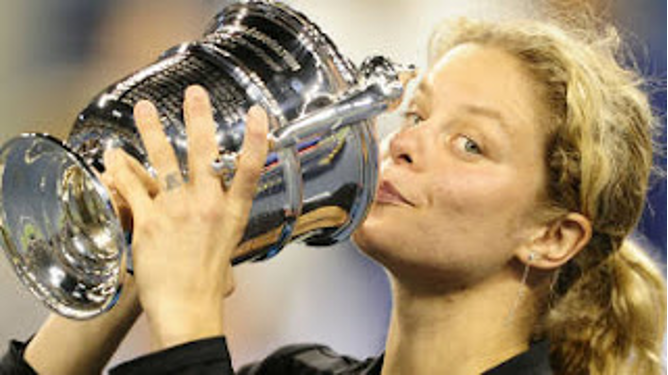
King, a four-time US Open winner and founder of the Women’s Tennis Association has fought for gender equality in sports and society. She was born working class parents when opportunities for women in professional sports were slim to none. Her parents could not afford Stanford or the University of Southern California so she played tennis at Cal State Long Beach. Such life experiences makes it that much more fitting that for 11 months of the year, the USTA Billie Jean King National Tennis Center is open to the public seven days a week. Except for Thanksgiving, Christmas, New Year’s Day and of course the Open, anyone can play on the same courts that hosted the newest winners—Rafael Nadal and Kim Cjisters!

As “made for television” as any sport might be, TV can never replicate all that you learn in attending a live sporting event. The vibe, the diversity of the crowd, and the excitement that comes with watching tennis at its highest level no wonder the motto of the US Open is “it must be love.” It was.

PHOTO CREDITS: