Showing posts with label Derek Jeter. Show all posts

Saturday, May 17, 2025

A Graduation Message from Derek Jeter at The Big House: Silence Made Me Better

It's graduation season. queue up "Pomp and Circumstance." We teachers dust off our black robes and hoods. Students are measured for their own. I was in the academic dean's office at school when three girls stopped by to confirm how to correctly pronounce their surnames. I know this assistant principal takes great pride in doing that right. She should!

At this time of year, one question I enjoy asking my colleagues at lunch is: Who gave the commencement address at your graduation? Many don’t remember. Some can give a general idea or share a few details. But I have a feeling the University of Michigan’s Class of 2025 won’t forget theirs. He is the 2020 MLB Hall of Fame inductee, five-time World Series champion, and legendary shortstop for the New York Yankees: Derek Sanderson Jeter.


Born in New Jersey, Jeter grew up in Kalamazoo, MI . Given that "The Captain" was a Wolverine for one year before turning pro, I wasn’t surprised by the University’s choice. I’m not a Yankee fan. I like Michigan even less, but he hit it out of the park (sorry! I couldn’t resist). I laughed. I cried. I watched it twice.

As a baseball player, I suspected he would address the importance of failure—as a mechanism for personal growth, humility and more. He did. 

If I can promise you one thing for certain: You will fail.I failed publicly. I failed miserably. There were days I literally cried because I was so bad. My first season as a professional, I made 56 errors. For the non-baseball fans, that’s hard to do intentionally.

The important thing, is to see disappointment as an opportunity to learn, not as a reason to quit.

It’s your job to make sure that a speed bump doesn’t become a roadblock.

Surrounding yourself with the right people will also help buoy you after a failure — and make your chance of success greater.

Easy for a baseball player to say, right? But to me Jeter's message had added nuance and depth. I couldn't help but think of his time with the Miami Marlins. Three years after retiring from his work on the field in baseball, Jeter became CEO and part of the ownership group. In 2022, he left his position of overseeing business and baseball operations; the Marlins had a mixed record under his leadership. To say he failed might be unfair. He faced a series of speed bumps. The road took him elsewhere.


Jeter has always spoken about the importance of his parents—the expectations they held, the way they challenged and supported him. As written in
The University Record:
While you may fail on your own, Jeter said, it’s nearly impossible to succeed alone.

For Jeter, the right people included his parents. 

“I’d walk onto the field to warm up before a game, and I’d look up into the stands. People thought I was looking around and not focusing. I was really looking for mom and dad,” he said.

“It gave me comfort that I wasn’t alone, even when they physically weren’t present, I knew they believed in me, were rooting for me, were supporting me.” 

Jeter’s words remind me that true greatness comes from both within and beyond. Simone Biles — who, fittingly, spoke at St. Louis University’s commencement — has expressed the same truth. Before every competition, she would look to the stands for her parents. But during the 2021 Tokyo Olympics, COVID restrictions kept families away. Biles cites this absence as a key factor in her mental health struggles.

The importance of family support and the lessons we learn from failure are important but standard remarks for graduates. What I found particularly poignant was his recommendation for silence. He said, 

I spent my entire career playing in the biggest media market in the world. The glare was constant. The attention was relentless. Many called me mysterious, amongst other things — but we'll use 'mysterious' — because I kept things private. In reality I was just listening to the voice in my head. It was my dad's voice. He kept telling me, 'Be patient.' Listen more than I spoke. So I looked. I listened. I learned. Silence made me smarter. Silence made me better.

Catholic writer Matthew Kelly would agree. He says we must all spend time in the classroom of silence. This is where Jeter found his way. You won't find a singular faith tradition or world religion that underestimates the importance and the power of silence. It's restorative. It's generative. It's where the Lord comes to us.


Though I have heard the band play "The Victors" many times, I never knew the actual words to the Michigan fight song (*I am familiar with an alternate version). Awarded an honorary Doctor of Law degree, his message has addition meaning. "After all, that Michigan degree that you are receiving today gives you an edge. And so do the words of our fight song: Hail to the victors, the conquering heroes, the leaders and best."

Thank you, Captain for these lessons—even about the fight song. Congratulations to all the graduates in Ann Arbor and throughout the country. Enjoy your moment and live the message.
Go Irish ;-) 

Photo Credits
Commencement
Biles
Silence

Monday, October 13, 2014

Two Words Jeter Was Never Allowed To Say...

Knowing we had a hard work out scheduled for cross country practice that afternoon, I shimmied up to a group of about 3o of my runners and said with great enthusiasm: "Girls! Imagine a world where everyone said "I can't!!" They looked at me as though that would be horrible. They should have.

I can't tell you how many punch lines I have completely botched when telling a joke. Or sometimes I get so excited while telling a story that I ruin the details. I say things like "Eminem is from 10-mile" with complete sincerity (it's 8-mile). I wish I could say it's a creative way I get people's attention but really, it's just a quirky part of my humanity. And in this case, what I meant to say is "Imagine a world where NO ONE said I can't." I fumbled this life lesson because I was so inspired by the great Derek Jeter whose final game in 20 years of MLB took place this September. 
Raised right by his parents Dot and Charles
In Tom Verducci's article "Exit Center Stage," I learned that Jeter's parents "never permitted Derek to use the word "can't" around the house. Anything was possible with hard work. There is no doubting whence comes his distaste for negativity." If Jeter could think that way, couldn't my runners think in a similar vein? Even if just for 2.5 hours?

As a teacher, a coach and a Christian, I believe it's my duty to give people hope. I think it's important to "find a way" when life is challenging. Removing the words "I can't" from our vocabulary is no easy task, but I think it's worth considering. One of my favorite passages of Scripture is "with God all things are possible." On my best days, I know this is true. Other days...not so much. 

Part of me, can't believe the BoSox did this. (Can't intended)
In reflecting on Jeter's example, I realized I say "I can't" literally and metaphorically quite a bit. The first place I noticed it will come of little surprise to those who play golf. Indeed, the golf course is a breeding ground for said words of contempt, but I soon realized there are many others.

Just one hour after XC practice, I played a quick round of nine holes. To my delight, I maintained solid contact on one one shot after another. That is always a moral victory. In fact, I hit the ball so well on one hole, I didn't mind that it landed in the bunker. 


I descended into the sand with a spring in my step and approached the ball with no fear. It was a hard shot, but I was feeling great. I swung my sand wedge and found my ball back where it started. A tough lip, it didn't clear the edge. I took another swing. Still in. I reviewed my stance, I looked at the open face and I said it, "I can't!" I thought about the fact that my next 8 shots might be from this very place and I said "I can't!" again, this time out loud. 


Sometimes life feels like one big...
I couldn't believe it. The very words I had preached against were mine. And even worse, I believed them.


I caught myself. I took a deep breath and stepped back from where I was. I looked at the open sky and loosened up and told myself to refocus. I hit the ball 2 inches behind it and got it out and onto the green. Great shot.

The literal and metaphorical symbolism astounded me. How often are we caught in a spiritual sand trap? How many times do we try and try again to get out? We feel as though we never will. Why don't we realize the words "I can't" are of little help. How can we change our thinking? What is it that gets us out? 


Indeed, the spiritual sand trap is very real. There are so many things which tempt us to say "I can't." Perhaps you can't accept God's mercy. Maybe you can't continue to pray for someone. Recently, I've thought "I can't forgive this person..." I know this because I have wanted Serena Williams' words to be my own. 


Serena. I get it.
In the 2012 US Open, she was so frustrated by calls from the line judge that she lost it. In a fit of anger, she said: "If you ever see me walking down the hall, walk the other way." Forgiving someone means I'm able to walk down the same hall and look them in the eye. Right now, that seems impossible. With God, however, all things are possible.

What I've come to believe is that if we want to get out of the sand trap, we can't say "I can't." (In one case using "can't" is ok here!) We have to look up to God. We have to take in a breath and regroup. 


Building the Kingdom of God here and now isn't easy...but I'm certain it requires the optimism Jeter was raised with. It's something we can do, little by little and day by day. Let every "can't" become a "can." Can I get an "Amen?"

Photo Credits
Jeter Family

Fenway Honors Jeter
Bunker
Serena


Thursday, September 25, 2014

Jeter's Way: Life Lessons from #2, Derek Jeter

If you haven't seen the Gatorade ad that bids farewell to Yankee shortstop Derek Jeter, stop reading now, and give it a go. It couldn't be more iconic. The black and white film, the filter, the backdrop of the New York City skyline as it meets the streets of the Bronx. Jeter appears as well—Jeter. He is accessible enough, he is adored by everyone, he offers a funny quip and emerges as a legend onto the field that creates them. And, it's set to Frank Sinatra's power ballad, "My Way." After reading Tom Verducci's tribute, "Exit Stage Center" in the recent, timely issue of Sports Illustrated, I believe it's worth reflecting on "Jeter's way."
I submit that Jeter's way is worth reflecting on in our own lives. They don't call him "Captain Clutch for nothing."

Leadership: "FORTUNE ranked him the 11th greatest leader in the world, 22 sports ahead of Apple CEO Tim Cook." 


Jeter said "One of the biggest things about is you have to get to know your teammates. You have to get to know who you're leading because there's different buttons you push with different people. Some guys you can yell and scream at, and some guys you have to put your arm around. You can do that only if you get to know them as people."

In light of Jeter's philosophy on leadership, how do you get to know those you are trying to lead? "Asking questions" and "spending time with someone" are obvious answers. But what are some practical things a good leader adds to the mix? 
Optimism vs. Negativity: "I always hear people say I give the same answers or I don't give you much. No, I just don't give you much negativity. When people are negative a lot, it starts to creep into your mind, and then you start having doubts, and I don't like that. If there's another way, show me. My job is to stay positive. My job is to limit distractions. And if you get annoyed by that, I don't expect you to understand because you're not in my shoes." 

How much negativity is in your life? Do you make an effort to stay positive? How do you limit distractions? 

The importance of mentoring & having fun: "Tim Raines, the one Yankee who could laugh off a slump or needle Paul O'Neill about being up a water cooler, became another influence" writes Verducci.

"I learned from him to have fun," Jeter says. "He had fun every day. That's a big part of being able to play all those years: to enjoy yourself."

Is there someone or something that makes your work fun every day? Seek them out. How or when do you enjoy yourself at work? Is that something you can be intentional about?
Presence: "A former teammate, Matt Ruoff, this month telling The Press Democrat of Santa Rosa, CA 'You always wanted to sit by him. I know that sounds weird, But Derek gave off a presence."

Have you ever sought out the company of another because they give off a presence? Describe it. 
What type of presence might you give off?  What type of presence do you hope you give?

Purpose: "And our job—we're playing a game—but our job is to entertain and to bring joy to people, and I think people have appreciated it."

Why do you do what you do? It might not involve entertainment, but how might it be possible to bring joy to others through your work? What might people appreciate about what you do?


Can-do Attitude: Jeter's parents, Dot and Charles, "never permitted Derek to use the word can't around the house. Anything was possible with hard work. There is no doubting whence come his distaste for negativity."

Can you imagine the world without the word "can't?" (maybe your response is 'no, I can't....haha!) I hear it every day at cross country practice. Today I told any runner who used those words the story of Derek Jeter. I also pointed out the best runners seldom if ever complain. Their attitude is can-do, not can't. 


How can we help young people work hard and appreciate its value? How often do I say "I can't?" How can I change my point of view?
The Dream: "I always dreamed of playing in the major leagues. But everything that comes along with it couldn't have possibly been part of the dream. Because it's been much better."

It's been better "Mr. November, Number 2" because you made it better. Thanks for doing it your way.

Photo Credits
Quote

Thank you

Friday, June 27, 2014

Happy 40th Mr. November: A Few Things Worth Knowing about Derek Jeter

I never thought this day would come, and thanks to the PGA, I can buy a little more time. But, I'm at the age where very few professional athletes are my age, or older. The great American poet, Emily Dickinson once wrote, “Old age comes on suddenly, and not gradually as is thought” And celebrating the great Derek Jeter's 40th birthday, just yesterday reminded me of that truth.
June 26, 1974. 40 years young...
Many would scoff at the idea of 40 as old age, but for those of us recently doing what we can to accept the new number, it's hard to deny it feels otherwise. Indeed, it's a milestone. I have yet to type in those digits when the treadmill at my gym asks me. Height and weight? No problem. My age? Not a chance. However, 40 has also ushered in the invitation to reflect back upon all the graces in my life, accomplishments and personal growth and it has harkened me to look ahead to what is next. I don't doubt it's any different for "Captain Clutch" as he bids farewell to Major League baseball this season.

I'm not a big Yankee fan but I do love baseball; it's hard to deny the professionalism, class, and gifts Jeter has brought to it all. In that spirit, I thought I would offer a few thoughts on what any sports fan can and ought to appreciate about Number 2.
"The Captain"
Elected in 2003, Jeter has the longest tenure as captain of any New York Yankee. Considering the legends that have worn those pinstripes, this is that says a lot. 

I once found myself in the middle of a very spirited debate about the need for captains in organized sports. I couldn't believe that so many athletic directors and coaches held passionate views against what I consider a key leadership role.

Part of what fueled my support for captains is that in times of real challenge or strife, we need peer to peer support. Captains are the go-to source to take action. No where was this more evident than among the Yankees in the aftermath of 9/11. The video "Nine Innings from Ground Zero" chronicles the role that baseball played in re-stabilizing a community in mourning, in offering people a place to gather and a temporary escape from the necessary work among wreckage, and more. 

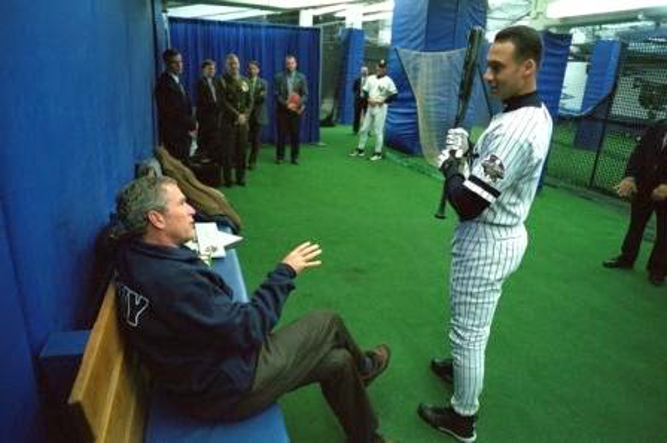
The role Jeter played is incredible. To say he must have been very uncomfortable at times is an understatement. He had to have asked himself "I'm supposed to make this better?!" But he showed up at firehouses and the armory. He called a young girl whose father was the pilot on Flight 93. He even met the President in the bowels of Yankee Stadium and urged him to throw a strike, from the mound. And of course, what he did on the diamond leads to...
Why He's Mr. November
For those of you who do know, I envy that your guy did what he did, when he did. And if you don't know, please stop reading right now and get your hands on any video clip that demonstrates how he earned this nickname (again "Nine Innings from Ground Zero says it well)

Remember, the Yankees already had a "Mr. October" in Reggie Jackson. But here's a clue. Since baseball was delayed after the events of 9/11, the World Series games were played in the month of November.... simply magic.

Jeter doesn't speak Spanish
Evidently, baseball players who don't know otherwise come up to Jeter all the time and start speaking in Spanish to him. Because of his skin tone, people often think he's from the Dominican Republic, like many other players in MLB. Not exactly..


Jeter was born in to Pequannock Township, New Jersey to Sanderson Charles Jeter, Ph.D. who is African American and Dorothy (nee Connors) who is of Irish and German descent. Maybe all races, creeds and cultures want a hold on him. I certainly see this in Michigan fans. In 1978, the Jeters moved to Kalamazoo, Michigan. Although he was recruited to play baseball for the Wolverines, he went pro right out of high school.


His contract
I'm not talking about the one Jeter's agent acquired for him that kept him with the Yankees for his entire career. No, I'm talking about the contract that Jeter's parents had him sign growing up. I would like to know when he first signed it, but every year Jeter signed off on what was acceptable and unacceptable forms of  behavior. I think it's brilliant.

We all do better when we know what those we love and respect expect of us, value and appreciate. Seems to me a contract sends that message loud and clear....and that it paid off!
There's only one #2
His Career
I'm not a huge Rick Reilly fan, but I love his piece "Jeter State of Mind." This fictional letter to Jeter's future children notes how incredible and unique his career has been. Reilly writes

He was the best player in baseball for a good 10 years straight and yet he never won a batting title, never won an MVP, never was the highest-paid player in the game. The only thing he did better than anybody else was excel: five rings, 13 All-Star games, the greatest New York Yankee since Mickey Mantle.
We've heard time and again that "age is just a number," but as far as I'm concerned, age...and numbers DO matter. We celebrated Jeter's 3,000 hits. When they retire his number, #2, I'm not sure any single digit numbers will be available for future New York Yankees. We'll look back on all he did and numbers will play their part when he was 18, 30 and 40. This fall, when we bid farewell to this baseball great, it will be hard to deny there are many great players in baseball, but there's only one Derek Jeter. Happy 40th my man. Welcome to the club.

Photo Credits
Jeter State of Mind
One Jeter