Renown American authors Kim Kardashian-West and Nicole "Snookie" Polizzi confirmed what we already know: anyone can write a book. Perhaps Kardashian's collection of "selfie-photography" contained in "Selfish" should be referred to as something other than a book. I thought books required reading, no? But, a recent find at a thrift store, List Your Self: Listmaking as the Way to Self-Discovery" caught my attention in the same way that Snookie's "Baby Bumps: From Party Girl to Proud Mama and all the Messy Milestones Along the Way" attracted those that love reality TV.
Perhaps you would rather have blood drawn than own a book about making lists. Perhaps you feel fully human, fully alive ;-) when you create a list and complete it. It seems as though there are no means between the extremes. Folks reside in the pro or con list camp, no? Where are you?
Let's face it, lists are everywhere. Bucket lists, Top 100 lists, the proverbial To-Do list and more. However, the authors, Ilene Segalove and Paul Bob Velick got me thinking of lists as
something other than what I scratch down on a scrap of paper, or the offering of multiple apps. That's because Segalove created lists in multiple categories: Yourself, Daily Life, Men and Women, Health, Business, Change, Greater Truths, Growing Up and Suddenly. In the introduction, she made a compelling reason for engaging such lists. She writes.
For some reason, we love to ignore who or what we really are. But being truly human and liking it requires self-knowledge. It gives our experience resonance. It lends a vibe, an echo, a wholeness, personal investigation and new discoveries. It opens up the cracks and lets loose the bits and piece of ourselves we haven't met....yet. List Your Self unlocks the door to your personal identity.
Whoa...unlocking my personal identity? Hmm... She continues,
At first, the idea of jotting down a list seems almost too mundane, just another task to get done. But once you start, you'll suddenly discover an inventory of personal secrets, fears and desires that flow out effortlessly and surprise you. There you are, big as life, in list form.
Listmaking is journaling at its best. Why? It gives you the chance to complete a task. When you journal, you make entry after entry. There's no closure in sight. But with list making List Your Self has an ending. There are no wrong answers. And every time you finish a list, you finish a huge thought, pull up a memory and diver into or put to rest a major psychological story.
The archaic root of "list" means "to listen to." To what? Eavsdrop on yourself. All day long, you are busy whispering all kinds o things to yourself. Grab that on-going dialogue and put it in a list. Do some personal eavesdropping. You'll be glad you did.
But there's one category that they forgot. Sports and Spirituality. So...I've created my own. Have fun with these prompts...err lists. No need to cross anything off from them
List Your Self: Sports and Spirituality Style
- List the 10 Athletes you would like to meet the most.
- The sports you wish you could master.
- The sports you learned as a child.
- The athletes or coaches you think have made the greatest
impact on the world.
- ....who have had the worst impact.
- List your athletic rituals.
- List any rituals you have as a sports fan (something you always do when watching your favorite team).
- List the sports you play, the athletic venus your visit when you want to get away.
- List the sports stories or moments that make you cry.
- List your athletic talents.
- List your athletic daydreams.
- List all the things you'd like to say to your favorite coach.
- List all the ways you tried to make your teammates happy.
- List the athletic memories you'd like to forget.
- List all the sports you can't live without.
- List the sports movies you've seen that were really worth two hours of your life.
- List all the nice things you've ever seen a professional athlete do for a fan.
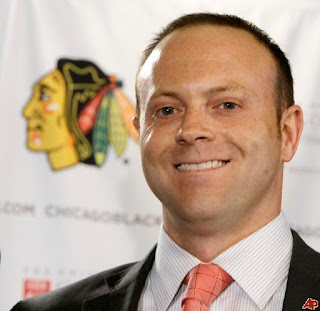 |
| Stan Borman, ND '95 |
You know you're old when It's one thing when professional athletes are no longer your age...For most of my life they were older than me—a lot older than me. With Steve Nash retiring this year, I have come to accept new roles for my peer group. I have found one in Stan Bowman, the President and General Manager of the Chicago Blackhawks.
I remember Stan as a fellow undergraduate student at Notre Dame. He is one year older than me and we had friends in common. His father, Scotty Bowman was the head coach of the Detroit Red Wings. Stan wore a faded red hat that bore the teams name almost every day. For some reason, we thought it was very funny that he was named after the sport's highest honor—the Stanley Cup. Look who's laughing now.
But that's not why I wanted to write about the NHL champions a few days after they captured their third title in six years in their 2-0 defeat of the Tampa Bay Lightning. Last July, I wrote about the usage of Native Americans as mascots: Saint Kateri Tekawitha: Proud to Be. That posting prompted a "Sports in the News presentation" in my Sports & Spirituality course. It spawned further questions and an ethical debate. With this posting, I would like to offer insights on how the Chicago Blackhawks contribute to this conversation.

First, the Blackhawks are not a tribe of native people. No. The team name refers to something different. As written in Sports Illustrated, "When coffee bean baron Frederic McLaughlin bought the Portland Rosebuds in 1926 and moved them to Chicago, he renamed the team after the 86th Infantry "Blackhawk" Division he commanded in World War I. His wife, Broadway dancer Irene Castle, had already introduced Americans to the bob haircut and the foxtrot before making her greatest contribution to pop culture. She drew a gallant Indian head for the new team's sweaters."
You could easily raise the question: Why should the face of a Native American serve as a hockey teams' logo. And if you stated the question that way, you are correct. How? Why? The mascot of the team is something different. The actual mascot of the team is "Tommy Hawk." I love what the team website has to say about him.
Tommy is the best mascot in the NHL. This feathery fowl loves to dance, play hockey and generally cause mascot mayhem wherever he goes. Tommy is not only at all Blackhawks home games, but Tommy makes numerous appearances throughout the Chicagoland area and the country.
Name: Tommy Hawk
Position: Center (of Attention)
Weight: 2,356 Hockey Pucks
Shoots: Pucks and t-shirts for the crowd
Resides: In Tommy’s Nest on top of the United Center
Hobbies: Playing hockey, reading, dancing, spraying silly string, laying eggs, getting the bird’s eye view
Favorite Foods: Roasted Duck, Pickled Penguin, Coyote Burgers, Buffalo wings
Favorite Song: Here Come the Hawks, Freebird, Shake ya Tail Feather,
Dislikes: Detroit, being called an eagle, getting his tail feathers plucked.
It's fitting that Tommy Hawk is the mascot because that term is derived from is the French word "mascotte” meaning a charm or luck. A mascot is a way to represent a group with public identities, such as a school, pro sports team, military unit or brand name. In fact, has traditionally been understood to be a person, animal or object thought to bring luck to this group. Today, we are aware of it in another context. It is a highly marketed representative of the organization, in sports used for merchandising.
But what is worth paying attention to is that among many sports teams, nicknames and mascots are not interchangeable. For example, the University of Alabama is nicknamed the Crimson Tide. Fans yell “Roll Tide!” Their mascot, however, is Big Al: an elephant. And as with the NHL Champions, you have a mascot that is a bird and a team name that refers to a division of the military. So what gives with the illustration that adorns the Blackhawks jersey loud and proud, front and center.
I don't know that I can or should answer that question. I am open to hearing and learning from others (but I think it is one of the most regal and striking logos there are. A native person himself said it was "bad ass'). However, what I did learn in my other research is how and why the term "Redskin" is offensive. As I wrote about before, "Redskin" refers to a bounty, the number of heads that were brought in as the kill. No longer is a native person a human being, they are a cash prize.
The article Why Is the Chicago Blackhawks Logo Okay but Washington Redskins Racist? states "The Hawks don’t use a caricature or slur that other teams have come under fire for. In fact, there is almost zero Native American 'stuff' used by the organization other than just their very famous logo. Read more here
I hope you will consider these questions and give them more thought. In the meantime, congratulations to my peer, Stan Bowman '95 and the Chicago Blackhawks
- Should we continue to use people as mascots? As logos? For marketing purposes?
- To what degree does a person as a mascot compromise human dignity? To what extent does it build/honor human dignity?
- Why have Native Americans been deemed as mascots more often than other groups? Why are they used as logos for so many others?
- What is lost when we are politically correct? What is gained?
- How often is basic respect mislabeled as “politically correct?”
Photo Credits
Logo
Stan Bowman
Tommy Hawk


