Showing posts with label Andre Agassi. Show all posts

Thursday, January 22, 2026

On the Other Side of Tired: A Book’s Return and a Life Revisited Thank you, Andre Agassi!

I love to ask questions about books. What is your favorite? Do you prefer fiction or non-fiction? Do you have a favorite writer? Are you partial to a "real" book or Kindle? Do you use the library or shop Amazon? And do you re-read certain books? Why or why not?

One of my favorite books—and probably my favorite sports read—is a work of nonfiction; it is Open by American tennis player Andre Agassi. His autobiography captivated my attention and imagination because, at one point in my life, I was madly in love with tennis. I was both a player and a fan. Reading his stories and recalling those memories transported me back to an era I followed closely. I knew the players, the rivalries, the highs and lows, the victories and defeats—both on and off the court. Agassi’s chronicle left me with only one reaction: What a life!

I bought my copy of Open shortly after it was published in 2009. My dear friend Bill and I went to hear Agassi speak about the book in Palo Alto on a Friday right after school. Bill and I both taught in the Religious Studies department. He coached boys’ and girls’ tennis, and at that time I was coaching cross country. Part of what makes my friendship with Bill so special is his sheer passion for tennis and his remarkable knowledge of the game. Time and again I sought his technical analysis, recall of specific points, and insight into the mental challenges of the sport. The only complication was that I had to be sure he already knew the outcome of a match before bringing it up. Why? He watched many of them on tape delay. Teaching and coaching keeps you busy.

with Bill at Indian Wells Center Court, 2009

To hear Agassi speak with that same depth—only magnified by lived experience—was unforgettable. He brought the pages of Open to life, blending candor, humor, and vulnerability in a way that made the afternoon feel both intimate and electric. It remains one of those shared moments that, even years later, still spark gratitude and a smile. We reminisce about this experience often (I am so bummed we did not take a picture with Agassi!!!)

I integrated Open into my curriculum as much as I could. However, Agassi retired in 2006. In spite of his eight grand slam titles and former number one ranking, his star power had naturally faded. Still, I found an ideal audience for his lessons and insights in a group of parents who enrolled in an evening section of Sports and Spirituality. One mom was so eager to read more that she asked to borrow my copy. I loved the book so much that I was happy to pass it along to anyone willing to listen and learn.

At Wimbledon 2022

The class ended. Her son graduated. I moved to another school. And somewhere in all that transition, the book was lost in the shuffle.

I asked a colleague to follow up with the parent about getting my book back. It never happened. I eventually purchased another copy, but it wasn’t the same. My original had been signed. It featured a nameplate. It carried my tabs, highlights, and handwritten notes. I had done more than simply read that book—I lived with it. I uncovered analogies about life and love. I challenged the author's claims and marveled at his experiences. I made connections to spiritual truths and found meaning in the memories. That exact copy was a witness to those treasures. 

From time to time, I would think of my book and get upset. I have been told that if you lend something to someone, you should not expect to get it back. Seems like a lousy proposition to me, but I understand the guardrails and their purpose. I had no other choice but to let it go.

In the passing years, I have not re-read this book. However, I think this is a worthy proposition. Why? It's not that the book changes but we do. Life happens. We have new experiences—chosen and unchosen, welcome and unwelcome, gifted and graced as well as tragic and solemn. I think even a book like Open could speak to life—and my life—in new ways.

Last week, I returned from lunch to find a bag on my desk. Inside was the very copy of Open that I lent out six years prior. Inside the book was a very thoughtful note that said 

My sincere apologies for not returning your book in a timely manner. Clearly this is a beloved book given all the tabs and notes. I found it recently so I am sending my son to ensure this amazing book is reunited with its owner. Happy New Year!
I couldn't help but wonder what the universe might be telling me. I decided to take a look at what spoke to me in the past. The first passage I highlighted made me smile. Agassi writes
It's no accident, I think, that tennis uses the language of life. Advantage, service, fault, break, love, the basic elements of tennis are those of every day existence, because every match is a life in miniature. Even the structure of tennis, the way the pieces fit inside one another like Russian nesting dolls, mimics the structure of our days. Points become games become sets become tournaments, and it's all so tightly connected that any point can become the turning point. It reminds me of the way seconds become minutes become hours, and any hour can be our finest. Or darkest. It's our choice.

The theologian Ron Rolheiser believes that "God speaks to every element in the language it can understand." It wasn't my first language, but I speak the language of tennis proficiently. No accent. Somewhere in that love affair, God was speaking to me. 


I revisited my tabs and margin notes and found myself asking: why read fiction when real life can be this compelling? The climb back to world No. 1. His father betting on him as a boy against Jim Brown. A detour to Springsteen’s Reunion Tour in Paris during the French Open. Meeting Nelson Mandela with Brooke Shields. Falling in love with Steffi Graf—his wife and the mother of his two children. Those stories are still compelling...and incredible. I had to wonder how and why some stories come to us. And I questioned, what could I do to make others happen. Is that even possible?

That view of Open is too short-sighted. Agassi spent three years writing the book, and at the launch event he emphasized that he had to tell this story. It wasn’t surprising to hear that he wanted to make sense of his own life, but I was struck by his insistence on telling the truth behind what fans thought they knew. He admits, for example, that he hated tennis. Through writing Open, he came to terms with his father, his failures, his divorce, his injuries, and ultimately his identity beyond winning. He sought to offer hope through honesty — and even the cover image quietly proclaims that message.

Just love this photo. An iconic look at that era...

So why here? Why now? What was the universe trying to tell me about my very own copy of Open finding its way back to me. Next to this classic photo is a quote that I highlighted. It says 
I can't promise you that you won't be tired, he says. But please know this. There's a lot of good waiting for you on the other side of tired. Get yourself tired, Andre. That's where you're going to know yourself. On the other side of tired.
It's safe to say in the 16 years since I have read Open, yes, I have changed. But in under two months time, my entire world has been turned upside down as my mom has battling Stage 3 ovarian cancer. This terrible disease came on so incredibly fast and my mom, my family and I are all dealing with its demands, her frailty and struggles. She is tired of being sick. I don't know that I have ever felt this tired either. This journey isn't a short one, nor is it an easy one. I don't go at it alone but I take comfort in what this message offers for me, even if just for today. I need to read it...or this case, re-read it.

And for the record, I love Kindle. That being said, a story like this would never happen through that platform now would it....

Photo Credits
Andre and Gil is from OPEN

Wednesday, November 29, 2023

"The Tennis Bag is A Lot Like Your Heart...." Lesson from Andre Agassi

One of my all time favorite reads is "Open," Andre Agassi's autobiography. I quote the  American tennis legend in Sports and Spirituality on a regular basis. Here's the best one: The tennis bag is a lot like your heart – you have to know what’s in it all times. 

Tennis was my first (sports) love. As much time and thought as I've given to the game, I never thought of my tennis bag and my heart having much, if anything in common. And yet, that image has stayed with me. 

Practically speaking, I know exactly what is in my heart. Just last week, I made my annual visit to my electrophysiologist. Following an EKG, they ran a diagnostic of my heart health and a routine transmission report from my Abbott device. Reviewing that summary is always a little jarring. It reminds me of the medical technology that makes my heart work effectively. I don't really feel it and although I barely see it, I carry it— two wire leads which remain in normal limits. They are connected an ICD with a battery that has 4.4-5.1 years remaining longevity. Fortunately, there were no abnormal fast heart rates detected over the last monitoring period. A good report.

But Agassi is not speaking of the biological heart. This heart—it too, has size and shape.  The spark of life, fount of emotion, house of the soul – the heart lies at the center of every facet of our existence.  And yet, I think it's tough to pinpoint what it carries. On any given day, my heart holds hundreds of emotions, desires, feelings, and concerns. Some are heavy, others are confusing. However, when I think of my heart like a tennis bag, I get somewhere. For one, it's never empty. It's usually pretty full. I think of the standing items my heart, like those inside a bag—practical considerations, planning items, understandings, and more. 

Agassi writes,

No one but me … can pack the [water] bottles into my bag, along with my clothes and towels and books and shades and wristbands. (My rackets, as always, go in later.) No one but me touches my tennis bag, and when it’s finally packed, it stands by the door, like an assassin’s kit, a sign that the day has lurched that much closer to the witching hour.

“I obsess about my bag. I keep it meticulously organized, and I make no apologies for this anal retentiveness. The bag is my briefcase, suitcase, toolbox, lunchbox, and palette. I need it just right, always. The bag is what I carry onto the court, and what I carry off, two moments when all my senses are extra acute, so I can feel every ounce of its weight. If someone were to slip a pair of argyle socks into my tennis bag, I’d feel it. The tennis bag is a lot like your heart – you have to know what’s in it all times."

How fitting. Be careful with what you pack. You're in charge. If there's something to obsess over, maybe that's it. Keep your heart organized—desire is a powerful force. The heart, like his bag, provides sustenance, nourishment, it carries provisions and allows us to create something new. We bring our heart into the workplace and we take it home. It is worth its weight, even when its heavy. Keep close to it. Take inventory. And hold on tight.

Photo Credits
Inside the bag
Andre

See a former posting related to this topic: What's in your backpack? tennis bag? heart?

Wednesday, August 28, 2013

The US Open: AMDG

Considering that my vacation started on June 1, I'm not looking for any sympathy. But, I'm exhausted. I have no doubt my fellow teachers would agree. The beginning of the school year is akin to getting a plane off the ground.  It takes tremendous energy and momentum to get a flight into the air. Teaching high school just isn't much different. Which is exactly why I am grateful for the fourth and final grand slam of the year—the US Open. 
Andy Murray will defend both his 2012 US Open title and the last grand slam event—Wimbledon 2013

The US Open is the contrast I need. For the past ten years, I came home from a full day of teaching and coaching cross country unable to move. The couch is my solace, ESPN my savior. Watching the world’s greatest tennis players grind it out late at night in New York is electric. My body may not move, but my mind revels in seeing these elite athletes sweat it out under the lights.

On the rare occasion that I caught a brilliant match or an epic upset, I could not wait to return to school the next day to discuss it with my colleague Bill, a tennis fan and tennis coach. The energy excitement from a great match gave a me a buzz better than my morning coffee. 

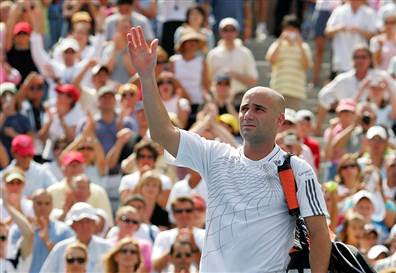
The U.S. Open that will forever stay with me was in 2006: Andre Agassi’s final championship. My student, Matt, was proud of his Cyprian Greek heritage. Imagine his delight when the number eight player in the world, Marcos Baghdatis from Cyprus played Andre Agassi.

In his autobiography "Open" Agassi relives that incredible night.
In the first round I play Andrei Pavel, from Romania. My back seizes up midway through the match, but despite standing stick straight I tough out a win. I ask Darren to arrange a cortisone shot for the next day. Even with the shot, I don't know if I'll be able to play my next match.
I certainly won't be able to win. Not against Marcos Baghdatis. He's ranked No. 8 in the world. He's a big strong kid from Cyprus, in the midst of a great year. He's reached the final of the Australian Open and the semis of Wimbledon. 
And then somehow I beat him, in five furious, agonizing sets. Afterward I'm barely able to stagger up the tunnel and into the locker room before my back gives out. Darren and Gil lift me onto the training table, while Baghdatis's people hoist him onto the table beside me. He's cramping badly. A trainer says the doctors are on the way. He turns on the TV above the table, and everyone clears out, leaving just me and Baghdatis, both of us writhing and groaning in pain. 
The TV flashes highlights from our match. SportsCenter. In my peripheral vision I detect slight movement. I turn to see Baghdatis extending his hand. His face says, We did that. I reach out, take his hand, and we remain this way, holding hands, as the TV flickers with highlights of our savage battle. We relive the match, and then I relive my life.
How many athletes can look at one another and say "We did that."

I remember that match, because despite my exhaustion, I didn’t fall asleep...I couldn’t go to bed until the winner prevailed. An Agassi fan, my heart went out to Matt and his kin. To read Agassi’s take-away from that evening confirms it was something much more than a routine or regular tennis match. Also, it was much more of a game. You can watch highlights here.

When athletes raise the level of the game to a place where one can reach out his hand to the other, where each can say “we did that”...not “I did that,” I have a much better sense of what AMDG means.

AMDG or “Ad Majorem Dei Gloriam” is the Latin motto for the Society of Jesus meaning “for the greater glory of God.” Perhaps you find its meaning self-evident, but I need some teeth to it. Questions that help me understand it include:

What does AMDG look like? When did I see it last? How would this community be different if AMDG did not guide us?  This match is a shining example. I can think of a few others—the 2013 Masters is one.  

What does AMDG look like to you?  Have you found it at a sports event?  The 2013 US Open is underway....teachers—put your feet up and enjoy!

Saturday, July 2, 2011

What's in Your Tennis Bag? What's in Your Heart?

I’ve been thinking a lot about the heart this past year—what it does as our most vital organ—literally and metaphorically. In late June 2010, I was diagnosed with a rare heart condition and implanted with a pacemaker/defibrillator. Essentially it aids my defective heart; potentially it can save my life. Pacemakers are fairly common; defibrillators and ARVD (my condition) are not. In a similar vein, I would like to think my beliefs about heart health are widely understood and accepted, but today I would like to offer one that is not.

In his autobiography “Open,” Andre Agassi says “The tennis bag is a lot like your heart—you have to know what’s in it at all times."

I am sure every cardiologist in America could read this and agree—hopefully there is an absence of cholesterol or plaque and instead it is a muscle that transmits oxygenated blood efficiently and effectively. But Agassi is speaking of something different.

What’s in your heart? Peace? Gratitude? Envy? Solace? Bitterness? Joy? Love? All of the above?

I hope my heart pumps virtue, but from time to time I find that some of the aforementioned vices creep in. For example, bitterness is both unattractive and insidious. Unless I am sincerely grateful, seeking to forgive others and myself, it slowly builds. No one will need a triple bypass to remove bitterness, but it’s a noteworthy image to remind us what can occur.

July 1 was the feast to the Sacred Heart of Jesus. In his posting “Why Pray to the Sacred Heart? Father Pat McCloskey, O.F.M states “This devotion, promoted especially by St. Margaret Mary Alacoque (d. 1690), was and is a way of softening the image of God as primarily lawgiver, judge and punisher. Devotion to the Sacred Heart says two things at the same time: Jesus is indeed fully human (people regard the heart as the seat of human emotions) and God forgives those who repent.” The Catechism (P:1439) reminds us that....Only the Heart of Christ who knows the depths of his Father's love could reveal to us the abyss of his mercy in so simple and beautiful a way. The devotion especially emphasizes the unmitigated love, compassion, and long-suffering of the heart of Christ towards humanity.


We are called to live like Christ and the Solemnity of the Sacred Heart reminds me that I am to love like Christ as well. That’s not an easy thing to do; the Gospel is testimony of Jesus’ love for those who society shuns. His example and the image of the Sacred Heart however, can serve as spiritual tools. With both in mind, perhaps I can live and love more like Him.

During the French Open, the Tennis Channel ran a series of ads entitled “Bag Check.” It was fun to see the many personalities on the tour run through their “briefcase.” And it’s been fun for me to think of it as symbolic of their heart.

Wimbledon finalist Novak Djokovic carries quite a bit in his bag. It’s entertaining to watch him pull out a gift from his brothers, a Serbian flag that he won via Davis Cup, a hat from his beloved homeland, a bracelet featuring the saints and a triptic of his patron saint. The metaphor comes to life; what’s in his heart is without a doubt in his bag.


Playing singles tennis for me can seriously compromise my heart health but golf is my new love. I now use my golf bag as my metaphor. What’s in my golf bag? What’s in my heart? Whatever your sport, take inventory!

Photo Credits

Agassi with his bag
Sacred Heart Icon
Djokovic's Heart is in Serbia

Wednesday, December 29, 2010

Best of 2010: Sports (Auto)Biography--
Andre Agassi's "Open"

I interviewed one of my favorite people in the world today, my friend Mike Caponigro, the co-creator of the “Catholics vs. Convicts” t-shirt. I wanted to get the official history of how the shirt, banned by the university was made and sold before the October 15, 1988 Miami vs. Notre Dame game. In a posting that will follow before the Irish play the Hurricanes in the Sun Bowl, Mike concluded his remarks with a question to himself: Would I rather have the money or the story? I guess the money…no wait a minute, at the end of the day; I would rather have the story.

He raised what I believe is an interesting point and an intriguing idea, a good card in life's game of “would you rather.” The victory? the money? the girl/guy? the glory? or the story? Perhaps it’s because I’m Irish (Mike’s Jersey Italian….close enough) but I agree, I'll take the story too.

And for the first of my 2010 “Best of” postings, the best sports auto/biography goes to Andre Agassi for his controversial autobiography “Open.” Why? the guy has the girl(s), the glory, the money, and a whole lot of victories. But this isn't what makes his book so memorable; he knows how to tell a good story.

Ironically “Open” begins with a chapter entitled “The End.” He writes
I open my eyes and don’t know where I am or who I am. Not that unusual—I’ve spent half my life not knowing. Still, this feels different. This confusion is more frightening. More total.I look up. I'm lying on the floor beside the bed. I remember now. I moved from the bed to the floor in the middle of the night. I do that most nights. Better for my back. Too many hours on a soft mattress causes agony.
The bad back, three decades of sprinting, stopping on a dime, jumping high and landing hard led Andre to retire at the age of thirty-six (young by most standard except for professional tennis). But he isn’t only speaking about retirement, or pain or self-knowledge, he is setting the stage for what this book reveals.
People would ask Agassi why he thought the end of his career was the appropriate time to write his autobiography. Why not wait until many years later—with time and distance from the game? Agassi conceded that it was therapeutic for him to undertake this endeavor. He reviewed hundreds of hours of game tape; he spoke with his coaches and trainers, reviewed interviews and more. Writing “Open” allowed him to make sense of the madness that is life on the ATP Tour. Tennis is played on six continents; it can be tremendously lonely and physically exhausting. But, it can also be pure entertainment. With Agassi’s active role as a US Davis Cup player, he came to appreciate a team dimension as well as the ultimate team—his wife—one of the greatest female players of all time, Steffi Graf. It doesn't have to be so lonely. Incredible victories, upsetting losses, his unconventional childhood, even the era he played all make for an autobiography that reads as a story.

It’s fitting, Agassi does not begin “Open” with the story of the last match he played, rather, he weaves in details of his life with his family on the tour, the cortisone shots he must take (whoa) all while leading up to what is final professional victory, against Marcos Baghdatis.

Ranked number eight in the world in the September 2006, I remember what a big and strong guy he was…and that he was Greek from Cyprus. I will never forget the school year was just underway and one of my students, a gentle giant was very proud of his Greek heritage. I happened to ask Matt Kosmas if he had family in Cyprus. He did. When I mentioned Baghdatis, he nearly went ape shit (I’m sorry, I typically don’t swear, but that’s the truth. Honestly, tell me how many Cyprian Greeks you know?!)Like the rest of the book, Andre doesn’t just recall details of the match, he colors the pages with his emotions, insights, how his supporting cast—coaches, personal trainer and family played their parts. His recall is phenomenal and so are his experiences and adventures.

After he defeats Bagdahtis in five grueling sets he writes:
By the time I reach the locker room I’m unable to walk. I’m unable to stand. I'm sinking to the floor. I’m on the ground. Darren and Gil arrive, slip my bag off my shoulder and lift me onto a table. Baghdatis’s people deposit him on the table next to me. ... He curls up into a ball and begs (his people) to leave him be. Moments later something makes me turn back to Baghdatis. He’s smiling at me. Happy or nervous? Maybe both. I smile back. In my peripheral vision I detect slight movement. I turn to see Baghdatis extending his hand. His face says, We DID that. I reach out, take his hand, and we remain this way, holding hands, as the TV flickers with scenes of our savage battle. It was a fun way to start the book; I was hooked.
I hate how the press that surrounded "Open" focused on his usage of Crystal Meth, not to mention his hair loss, and hollow marriage to Brooke Shields. I hate how he hates tennis—I don’t. Even when I went to hear him speak at a book signing/release, I thought he is still a bit of a punk. Not a lot of Andre and his life resonate with me. Yet what totally fascinated about his memoir were the places he traveled, the people he met, his genius of a mind for the game and his significant comeback in his 30s.

And by way of compare and contrast, I read Pete Sampras’ autobiography "A Champions' Mind." Poor Pete…truly one of the greatest players of all time and he made me yawn. Case in point, after he captured his seventh title at Wimbledon, he wrote “we went out and had a blast.” I’m sure you did Pete. My God, you’re the winningest male in the history of the tournament and that’s all you want to share? Vitas Gerulaitis is rolling in his grave (good, bad or otherwise).
If you like tennis, if you find strong personalities like his former coach Brad Gilbert highly entertaining, if are envious, like me, of people who continue to be in the right place at the right time—he played in the French Open when Springsteen and the E Street Band just happened to be on tour (he was spotted in the crowd and everyone yelled out “Allez Andre!”) this is the book for you.

Andre is not a religious person. He intimates at his spirituality, but in the most abstract way possible. Yet, Andre and I share a common humanity; despite the challenges he has faced, the contradiction he is and the abuse he has endured from family, the media and self, I am certain he would say, ultimately, “Open” is a story of one man’s humanity. I want nothing to do with "Eat, Pray, Love" or "Girl with the Dragon Tatoo;" this is one story worth reading.

NB: "Open" was released in 2009...I may be cheating here! I didn't get to read it until January 2010.

Photo Credits
"Open"
Steffi and Andre
Andre and Bagdahtis
Brad Gilbert