Showing posts with label AMDG. Show all posts

Sunday, December 18, 2022

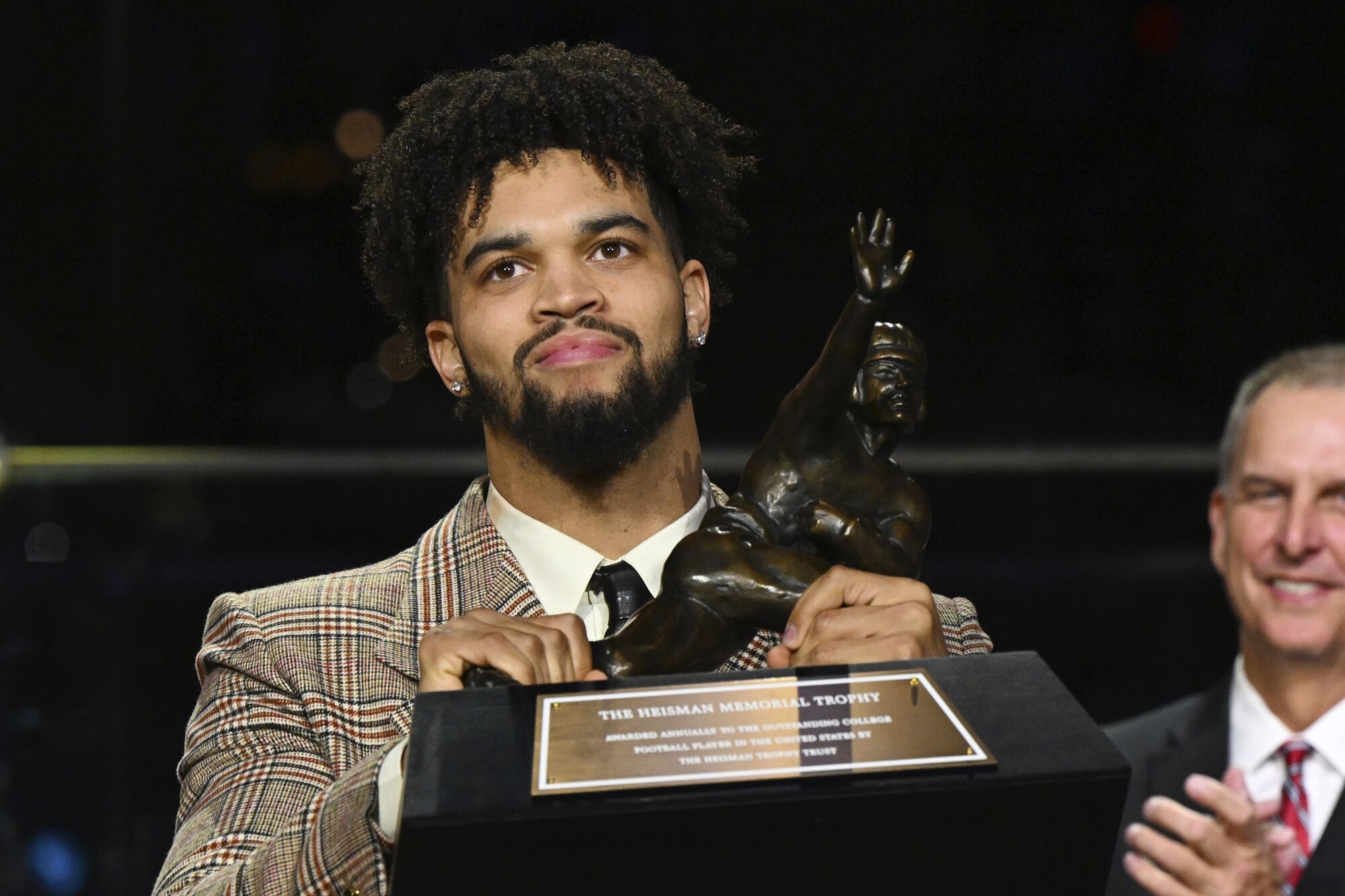
An Open Letter to Caleb Williams, the 2022 Heisman Award Winner

Dear Caleb,

Congratulations on winning the 2022 Heisman trophy. When I return to the LA Coliseum, I will look in the east zone for that jersey featuring your name and number— one among seven others in Trojan history. Impressive. 

I did not know that you graduated from Gonzaga College High School in DC until I heard your speech. As an educator in a Jesuit high school, I appreciate the credit you gave to your Catholic education for showing you how to be a man for others—a motto credited to Pedro Arrupe, SJ and known throughout Ignatian circles.
It was simply awesome to see the reaction of current Bulldogs when your name was called. So many of my colleagues in other Jesuit schools have shared your story. The connection from one school to another is significant. Your speech lit up my Instagram feed, as I follow the likes of Jesuit Schools Network, Jesuits West among others. Your win is a near win for Jesuit education and athletics!

In a statement to CNA, the president of your alma mater, Father Joseph Lingan, SJ said, “We remain proud of Caleb’s leadership both on and off the field, his charitable nature, and his gracious and humble character … on behalf of the entire Gonzaga Community CONGRATULATIONS CALEB!”

While I understand it is important to give credit where credit is due, I do not celebrate your nomination. I have serious doubts and concerns about lauding you as a graduate of a Catholic Jesuit school, given other messaging you have sent throughout the season. Those messages were visible and they were public. And, as the starting quarterback of the team, they were hard not to notice or see. They were on the fingernails of your left and right hands.

Many people know you paint your fingernails before a game. When asked "Why?," on Good Morning America you shared it is because of your mom. You said, "My mom was my inspiration, I mean, she's been doing nails since I could remember. And and she's always done it. I think since she was probably like 14, she's always done it." Painting of your nails is far from problematic. However, the message you have on them is.

You painted F*** ND, F*** UCLA and F*** Utah before playing each school.
As written on SportingNews, "He sported "F--- Cal" polish when USC beat Colorado in what seemed to be the ultimate disrespect. Against Washington State, he painted the Suicide and Crisis Lifeline onto his nails. In fact, the profanity seemed to come later on in the year, as they were often designs early in USC's season. He donned USC's logo in his debut against Rice, and against Stanford he put the Stanford logo onto his middle finger. It's not hard to figure what he means by that."

As I wrote in my post: Profanity and The Why: Questions from USC Quarterback, Caleb WilliamsI have no idea how demonstrating that type of profanity honors the game, your own team or your rival. I would argue that message goes against what sport is and should be.

You thanked your Coach Randy Trivers who is on campus as a faculty member—teaching both Classical and African American literature. I wonder, did you consider what he might say if asked "Why does your former player paint his nails in that way?" Is it consistent with his coaching philosophy?

You said, “Coach, you may not know this, but the Gonzaga mantra that you drilled into us, ‘men for others,’ has helped inspire me to create the Caleb Cares Foundation, which is all about giving back, so thank you coach, thank you Gonzaga.”

While I do not take for granted that you acknowledged and thanked your coach, I do not know how the words, being a man for others, permits participation in this type of pregame ritual. I have a strong suspicion that had you painted your nails like this in high school, one of your coaches would have noticed. I can't help but think J.U.G. is one possible consequence.

I write because it could have been different. The beauty of a motto or mantra is that it can guide a young person to live and love a certain way. But, they also run the risk of ringing hollow or hypocritical. This is where I raise my question: Why?

In 2009, the former principal of St. Ignatius College Prep (who happens to be a graduate of Gonzaga HS) noticed a picture in the front of Sports Illustrated. Written on the wrist tape of the Stanford offensive guard was the Jesuit motto: AMDG. 
It caught his attention. Why? Stanford isn't a Jesuit school, but the athlete who wrote it hails from one. Andrew Phillips is a graduate of Georgetown Prep.

I reached out to Phillips to find out why he did this. Much to my delight, he responded.

The Jesuits taught me that everything you did was meant to be done with the knowledge that your actions were giving glory to God. I always took a mindset as a player that my play wasn't just helping my team win, but as an expression of my talents it was actually a personal way of giving glory to my creator. There was something very centering in my ritual of putting those letters onto my wrist tape, and my wife even surprised me by having AMDG etched into the inside of my wedding ring. Though I hung up my pads several years ago, the principle of  Ad Majorem Dei Gloriam is still something I use as a guide in my daily life. 

How might your message be seen and heard differently had you painted AMDG on your nails? or in promotion of your own team?  Though I am not a USC fan, this nomination would serve as a notable affirmation of who we are and what we aim to do. Instead, I find the inconsistency deeply problematic. In fact, it invites me to double down and re-examine what we teach, value, promote and why. That is never a bad thing.

A platform used for the good is AMDG.

Sincerely,

Anne Stricherz
St. Ignatius College Prep
San Francisco, California

Photo Credits
Heisman
Nails

Saturday, May 11, 2019

The Power of a Logo: Whether We Know it or Not

With 20 minutes to spare before our tee time, my friends and I walked up to the snack bar, and stood behind a sea of Tar Heel blue. I took inventory: 6 young men were wearing the same collared zip sweatshirt and hat, replete with interlocking NC logos. To their right stood a man slightly older than them in the same Carolina blue. I smiled at him and said "Coach, are you playing in a tourney here today?" We talked and I came to learn they were practicing before the NCAA Men's Golf Regional at Stanford University. I looked at the ACC logo on his sleeve and asked "How many ACC teams will be there?" I paused and pointed to my own jacket and said, "For example, will Notre Dame be there?!" I smiled again.
We represent our schools, causes, country and state, sports teams and clubs, passions and people all the time in ways both big and small. From a logo on your favorite sweatshirt to a sticker on your car window, we do a lot of marketing without even knowing it! We promote and publicize our allegiances before and after game day. I love connecting with others in this way.

However, today I was reminded that representing our school, our place of work, our alma mater or a community of personal import with a hat or shirt, golf bag or jacket isn't something we should treat lightly. Why? Because whether we know it or not, we send messages to others all the time. We observe color and symbol. We take inventory and look up and down, far and wide, and we take notice. What do they say? How do they say it. Indeed, people infer and deduce quite a bit about who we are with words and perhaps more loudly without them. 


For example, from time to time, I can be an aggressive driver. I have cut other cars off or switched lanes at the last minute, holding other vehicles back. It's not ok—and I know this by an action I consciously and subconsciously take. On the driver side window of my Jeep is a sticker that reads "University of Notre Dame Alumni." This gold square has an interlocking ND in the middle of it. When I have been
 a selfish person behind the wheel, I roll down that window. I don't want anyone to see that I went to Notre Dame. I don't want them to associate this gesture with other alumni. To some people that might sound ridiculous but to me, it's how I feel. I want others to have respect for ND graduates rather than contempt. A tall order I know, but I look at others in a similar vein.

This truth was reflected back to me in an unusual experience when my friends and I went to tee off—post snack bar—for our round of golf. The two men in front of us were late and should have joined the twosome they were paired with. Rather than apologize or explain what went wrong, one man put the issue back on me. He was defensive and corrected me on the time (NB: it's a near cardinal sin to be late in golf....a 12:50 tee time means you should be in the tee box and ready to go ten minutes prior). I was shocked at how caustic and unfriendly he was in the circumstance. His arrogance did not just affect me and my friends, but the line of golfers after us. Everyone makes mistakes! This was not the end of the world, but a simple apology...a "my bad" or "we'll do what we can to catch up with the other two" would have been appropriate and appreciated. 

As I sought to make sense of what transpired, I looked at the bag of this golfer. On this faded red bag was the head of a Bronco; that meant he went to, and most likely played at Santa Clara University. I then caught sight of four letters embroidered on the side; it said AMDG. That was tough to see.
Students at Jesuit schools write AMDG at the top of a paper or beside their name as they begin an exam. Some place AMDG on their artwork; others let this motto serve as the header for an important essay. AMDG or “Ad Majorem Dei Gloriam,” is the Latin motto for the Society of Jesus meaning "for the greater glory of God." 

AMDG is not meant to be another decoration. AMDG is far from a marketing tool; the spirit of this motto should never ring hollow or untrue. The athletic director has told me that his biggest fear is someone will come up to a student and ask them "What does AMDG stand for and they won't know the answer." Therefore, coaches are called to actively lead with AMDG in mind and teach what it means: athletes are instructed to compete in a way that gives glory to God. They are reminded that sports is another way we can use our gifts and talents not just for personal gain, but as part of something much bigger than ourselves. Those letters are printed on team jerseys lest anyone forget.....and as I saw on the course today, on golf bags.

I have wondered how today's encounter with these two golfers could have been different. Thinking about it now, I think I would let those four letters: AMDG factor into our exchange. I wish I had paused. I wish I had given some silence after I asked what was going on (they knew). I wish I had said "Did you play at Santa Clara? I see AMDG on your bag." I don't know that things would have been any different, but I think I would be. AMDG means something to me. I know what it is and what it is not. That was far from how that motto is and what it calls us to be.

Again, all stones are cast to the side. I own my limitations and failings—but I am also an ambassador of the the places that have formed me, the communities I represent, my schools and teams, families and friends whether I want to admit it or not. In other words, I will do better behind the wheel so I don't have to roll that window down. I hope you will consider what this means in your life...

Photo Credits
UNC Golf
ND Sticker

Wednesday, August 28, 2013

The US Open: AMDG

Considering that my vacation started on June 1, I'm not looking for any sympathy. But, I'm exhausted. I have no doubt my fellow teachers would agree. The beginning of the school year is akin to getting a plane off the ground.  It takes tremendous energy and momentum to get a flight into the air. Teaching high school just isn't much different. Which is exactly why I am grateful for the fourth and final grand slam of the year—the US Open. 
Andy Murray will defend both his 2012 US Open title and the last grand slam event—Wimbledon 2013

The US Open is the contrast I need. For the past ten years, I came home from a full day of teaching and coaching cross country unable to move. The couch is my solace, ESPN my savior. Watching the world’s greatest tennis players grind it out late at night in New York is electric. My body may not move, but my mind revels in seeing these elite athletes sweat it out under the lights.

On the rare occasion that I caught a brilliant match or an epic upset, I could not wait to return to school the next day to discuss it with my colleague Bill, a tennis fan and tennis coach. The energy excitement from a great match gave a me a buzz better than my morning coffee. 

The U.S. Open that will forever stay with me was in 2006: Andre Agassi’s final championship. My student, Matt, was proud of his Cyprian Greek heritage. Imagine his delight when the number eight player in the world, Marcos Baghdatis from Cyprus played Andre Agassi.

In his autobiography "Open" Agassi relives that incredible night.
In the first round I play Andrei Pavel, from Romania. My back seizes up midway through the match, but despite standing stick straight I tough out a win. I ask Darren to arrange a cortisone shot for the next day. Even with the shot, I don't know if I'll be able to play my next match.
I certainly won't be able to win. Not against Marcos Baghdatis. He's ranked No. 8 in the world. He's a big strong kid from Cyprus, in the midst of a great year. He's reached the final of the Australian Open and the semis of Wimbledon. 
And then somehow I beat him, in five furious, agonizing sets. Afterward I'm barely able to stagger up the tunnel and into the locker room before my back gives out. Darren and Gil lift me onto the training table, while Baghdatis's people hoist him onto the table beside me. He's cramping badly. A trainer says the doctors are on the way. He turns on the TV above the table, and everyone clears out, leaving just me and Baghdatis, both of us writhing and groaning in pain. 
The TV flashes highlights from our match. SportsCenter. In my peripheral vision I detect slight movement. I turn to see Baghdatis extending his hand. His face says, We did that. I reach out, take his hand, and we remain this way, holding hands, as the TV flickers with highlights of our savage battle. We relive the match, and then I relive my life.
How many athletes can look at one another and say "We did that."

I remember that match, because despite my exhaustion, I didn’t fall asleep...I couldn’t go to bed until the winner prevailed. An Agassi fan, my heart went out to Matt and his kin. To read Agassi’s take-away from that evening confirms it was something much more than a routine or regular tennis match. Also, it was much more of a game. You can watch highlights here.

When athletes raise the level of the game to a place where one can reach out his hand to the other, where each can say “we did that”...not “I did that,” I have a much better sense of what AMDG means.

AMDG or “Ad Majorem Dei Gloriam” is the Latin motto for the Society of Jesus meaning “for the greater glory of God.” Perhaps you find its meaning self-evident, but I need some teeth to it. Questions that help me understand it include:

What does AMDG look like? When did I see it last? How would this community be different if AMDG did not guide us?  This match is a shining example. I can think of a few others—the 2013 Masters is one.  

What does AMDG look like to you?  Have you found it at a sports event?  The 2013 US Open is underway....teachers—put your feet up and enjoy!